Backlinks are links from another site pointing to your website. When reputable websites link back to your site, it signals to search engines that you have a credible website. The more reputable backlinks you have, the higher your domain authority and the more likely you are to rank for difficult keywords.
2. Bounce rate
This is the percentage of visitors who leave a website after viewing only one page and taking no action, like clicking a link. A high bounce rate may indicate that the site content is not relevant or engaging to users. As such, you want to aim for a low bounce rate.
3. Crawling
Crawling is the process by which search engines discover your website’s content. Search engine bots, also known as crawlers, follow links on your site to explore its pages and gather information about them.
4. Domain authority
This metric indicates a website’s credibility and its potential to rank for more competitive keywords on search engines. It’s influenced by factors such as the quality of links pointing to the site from other websites.
5. Indexing
Indexing happens after crawling. It’s when search engines store and organize the information they’ve collected from your site. This allows the content to be easily retrieved and displayed in response to relevant keyword searches.
6. Keywords
Keywords are the words or phrases people use in search engines to find information, products, or services online. As a website owner, understanding these keywords helps you decide what terms your site should focus on to attract visitors. Usually, a page will have a main keyword to prioritize and additional related words to help search engines understand what you should rank for.
For example, a Squarespace-related keyword might be “website builder” or “online store template.”
7. Keyword difficulty
This metric measures the difficulty of appearing on page one of search results for a particular keyword or phrase. Keyword difficulty is partly based on how many other sites are trying to rank for the same word and how reputable those sites are. Websites that search engines consider more trustworthy have a better chance of ranking for more difficult keywords. Many SEO tools, such as the SEOSpace extension, offer insights into keyword difficulty.
8. Long-tail keywords
Long-tail keywords are longer (three or more words), more specific search phrases with lower search volume but higher conversion potential. They often target niche audiences and are easier to rank for compared to short, highly competitive keywords. For example, instead of “shoes,” a long-tail keyword would be “comfortable running shoes for flat feet.”
9. Mobile optimization
This involves designing and adjusting your website to ensure it looks and performs optimally on mobile devices. Since Google prioritizes mobile performance, ensuring your site is mobile-friendly is vital for a good user experience and better search rankings.
10. Search engine results page (SERP)
The SERP is the page displayed by search engines in response to a search. Ranking higher on the SERP increases visibility and can lead to more organic traffic, as users are more likely to click on top-ranking results. Ideally, you’ll appear in the first three results of your relevant keyword’s SERP, as these results get the most clicks.
11. Search volume
Search volume is how many people search for a certain keyword or phrase online in a month. It shows how popular the phrase is and can help you decide whether it’s a keyword worth optimizing your site for. Generally, you’d only optimize your site for a keyword that has a search volume higher than zero.
12. SEO description (Meta description)
SEO descriptions, also known as meta descriptions, are the summaries that appear below the SEO title in SERPs. They give readers a quick summary of the page’s content.
Web users are more likely to click on a page that’s relevant to their search, so it’s essential to write a compelling meta description that highlights your page’s content and relevance. It’s recommended to keep your SEO description between 150 and 160 characters to ensure search engines don’t truncate it.
13. SEO title (Meta title)
An SEO title, also known as a meta title, is the clickable blue link you see in search results. It’s one of the first things people notice, so it’s important to make it attractive and engaging. On Squarespace, you can change a webpage’s SEO title in the page’s settings. Limiting SEO titles to 50-60 characters is recommended to avoid getting cut short in SERPs.
Note that an SEO title is not the same as the page title. A page title is what appears in your browser tab or when sharing a page link. However, you can use the same title in both places.
14. Sitemap
A sitemap is like a map of your website, showing all the pages that you want search engines to know about and display on SERPs. It helps search engines find and understand your content more easily, guiding them to index your site efficiently.
On-page SEO includes those tweaks you make to your website pages to improve online visibility. Here are some key on-page SEO terms you may encounter.
15. 301 redirect
A 301 redirect is a permanent redirection of a link/URL from one webpage to another. It helps guide both users and search engines to a new webpage when content has been moved or a page is outdated.
16. Anchor text
This refers to the visible, clickable text in a link. Optimizing anchor text with relevant keywords can help improve your website’s SEO by providing context to search engines. This is also beneficial for your website’s accessibility.
17. Internal linking
Internal linking involves connecting your pages with hyperlinks to improve site navigation and user experience. You can strategically link related content to guide visitors through your site and keep them engaged. This practice also helps search engines understand your site’s content structure, potentially improving SEO performance.
18. Robots.txt
This is a file that provides instructions to search engines about which pages on a website should be shown to the public. It helps manage website traffic and ensure sensitive or duplicate content is not shown.
19. Search intent
This term describes a web user’s aim when searching for a specific keyword. There are four main types of search intent.
Informational: Seeking knowledge (e.g., “how to start a blog”)
Navigational: Looking for a specific website (e.g., “Squarespace login”)
Transactional: Ready to make a purchase (e.g., “buy yoga mat”)
Commercial: Researching products or services before making a purchase (e.g., “best yoga mats”).
Understanding search intent is crucial in SEO. To target a keyword effectively, you must ensure that your web page content matches the search intent of the users you want to attract.
20. SSL certificate
SSL (Secure Sockets Layer) is a security technology that establishes a secure connection between a browser and a web server (a computer system that stores a website’s files and delivers them to users’ browsers when they visit that website). Having an SSL certificate is important for ensuring secure data transfer and can positively impact SEO rankings, as search engines favor secure sites over non-secure ones.
Beginner technical SEO terms
Technical SEO involves optimizing the behind-the-scenes elements of your website, such as how it’s built and organized. This includes improving site speed, ensuring mobile-friendliness, and making sure that search engines can easily crawl and index your site.
21. Alt (or alternative) text
Alt text is a description added to images on a webpage. It helps search engines understand the image’s content and improves accessibility for users who can’t load or view an image clearly.
22. De-indexing
De-indexing involves removing a page from search engine results. This process can be necessary for various reasons, such as removing outdated content or preventing duplicate pages from competing for rankings for a single keyword, a phenomenon known as keyword cannibalization. While it’s generally best to keep your content indexed, strategic de-indexing can sometimes improve your overall SEO performance by ensuring search engines focus on your most valuable pages.
23. Metadata
Metadata is information about your web pages that isn’t visible to users but helps search engines understand the page better. It includes elements like meta tags, image alt text, and schema markup. These hidden descriptors help search engines display your content appropriately in search results.
24. Page speed
Page speed refers to how quickly your website loads and responds to user interactions. Fast-loading pages keep visitors engaged and signal to search engines that your site provides a good user experience, ultimately improving your site’s visibility. Google recommends keeping page load times to under three seconds to reduce bounce rate.
25. Schema markup
Schema markup is a type of code you add to your website to help search engines understand your content more clearly. If you’ve ever seen Google display star ratings or FAQs directly under a webpage in search results, that’s schema markup at work. Using it can make your site stand out and may lead to more people clicking on your website’s link.
Staying informed
SEO is ever-evolving, hence the importance of staying updated about changes in search engine algorithms. These updates help search engines give better and more accurate results. By understanding them, you can modify your SEO strategies to boost your website’s rankings.
It’s also important to measure your site’s SEO performance. By assessing metrics like search rankings, website traffic, engagement, and conversion rates, you can determine the effectiveness of your SEO efforts. Use Squarespace Analytics to track these numbers and find opportunities to adjust your SEO strategy for improved results.
When you built your website, you likely created it with your users in mind, trying to make it easy for them to find and explore your content. One of those users is a search engine, which helps people discover your content. SEO—short for search engine optimization—is about helping search engines understand your content, and helping users find your site and make a decision about whether they should visit your site through a search engine.
The Search Essentials outline the most important elements of what makes your website eligible to appear on Google Search. While there’s no guarantee that any particular site will be added to Google’s index, sites that follow the Search Essentials are more likely to show up in Google’s search results. SEO is about taking the next step and working on improving your site’s presence in Search. This guide will walk you through some of the most common and effective improvements you can do on your site.
There are no secrets here that’ll automatically rank your site first in Google (sorry!). In fact some of the suggestions might not even apply to your business, but following the best practices will hopefully make it easier for search engines (not just Google) to crawl, index, and understand your content.
How does Google Search work?
Google is a fully automated search engine that uses programs called crawlers to explore the web constantly, looking for pages to add to our index. You usually don’t need to do anything except publish your site on the web. In fact, the vast majority of sites listed in our results are found and added automatically as we crawl the web. If you’re hungry for more, we have documentation about how Google discovers, crawls, and serves web pages.
How long until I see impact in search results?
Every change you make will take some time to be reflected on Google’s end. Some changes might take effect in a few hours, others could take several months. In general, you likely want to wait a few weeks to assess whether your work had beneficial effects in Google Search results. Keep in mind that not all changes you make to your website will result in noticeable impact in search results; if you’re not satisfied with your results and your business strategies allow it, try iterating with the changes and see if they make a difference.
Help Google find your content
Before you actually do anything mentioned in this section, check if Google has already found your content (maybe you don’t need to do anything!). Try searching on Google for your site with the site: search operator. If you see results pointing to your site, you’re in the index. For example, a search for site:wikipedia.org returns these results. If you don’t see your site, check out the technical requirements to make sure there’s nothing technically preventing your site from showing in Google Search, and then come back here.
Google primarily finds pages through links from other pages it already crawled. In many cases, these are other websites that are linking to your pages. Other sites linking to you is something that happens naturally over time, and you can also encourage people to discover your content by promoting your site.
If you’re open to a little technical challenge, you could also submit a sitemap—which is a file that contains all the URLs on your site that you care about. Some content management systems (CMS) may even do this automatically for you. However this isn’t required, and you should first focus on making sure people know about your site.
Check if Google can see your page the same way a user does
When Google crawls a page, it should ideally see the page the same way an average user does. For this, Google needs to be able to access the same resources as the user’s browser. If your site is hiding important components that make up your website (like CSS and JavaScript), Google might not be able to understand your pages, which means they might not show up in search results or rank well for the terms you’re targeting.
If your pages have different information depending on the user’s physical location, make sure you’re satisfied with the information that Google sees from its crawler’s location, which is generally the US.
It might be important for you to opt out your site as a whole or sections of it from appearing in search results. For example, you might not want your posts about your new embarrassing haircut to show up in search results. Google supports various ways that lets you opt out of crawling and indexing of your URLs. If you need to block some files, directories, or even your whole site from Google Search, check out our guide about ways to prevent content from appearing in search results.
Organize your site
When you’re setting up or redoing your site, it can be good to organize it in a logical way because it can help search engines and users understand how your pages relate to the rest of your site. Don’t drop everything and start reorganizing your site right now though: while these suggestions can be helpful long term (especially if you’re working on a larger website), search engines will likely understand your pages as they are right now, regardless of how your site is organized.
Use descriptive URLs
Parts of the URL can be displayed in search results as breadcrumbs, so users can also use the URLs to understand whether a result will be useful for them.
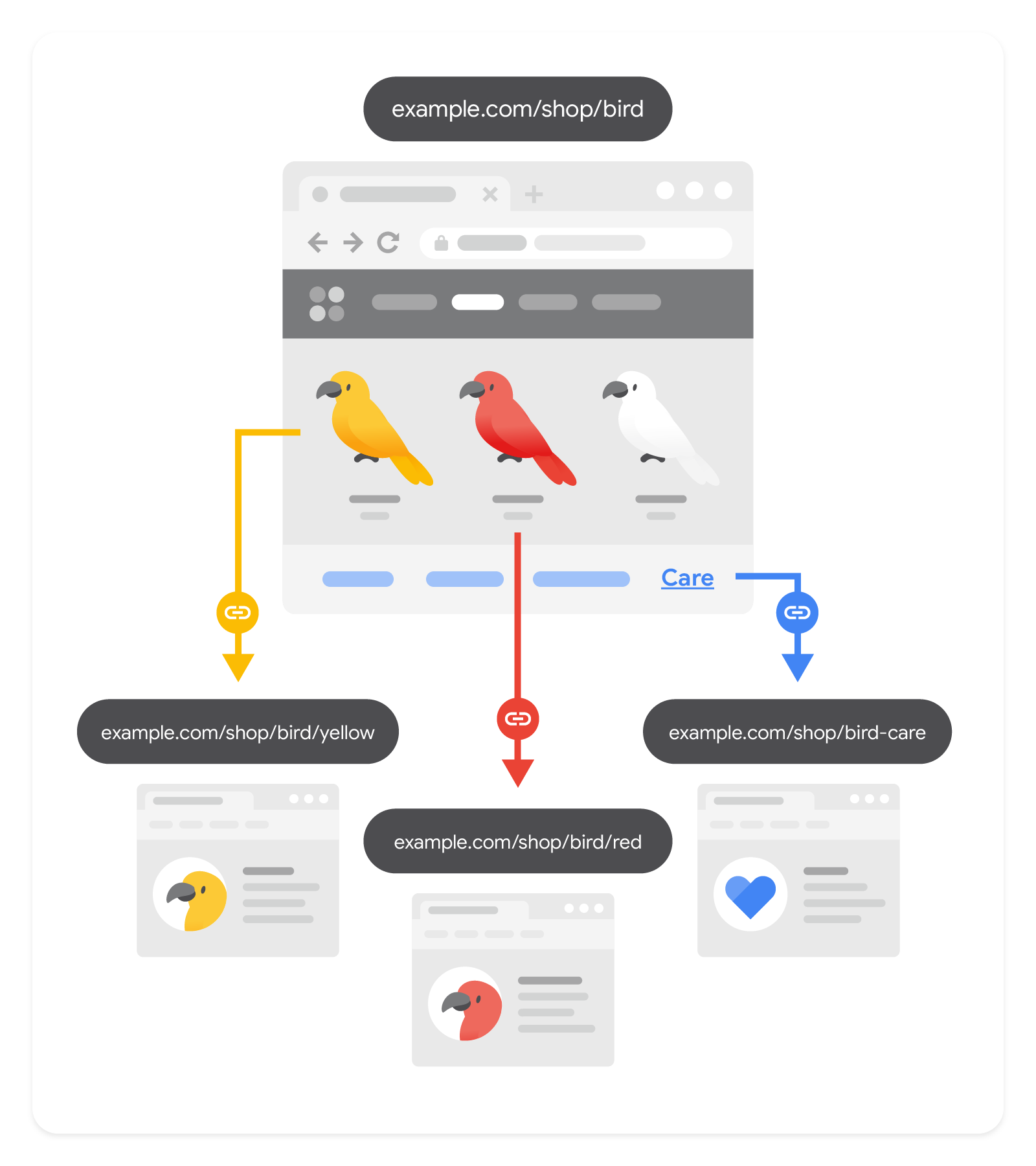
Google learns breadcrumbs automatically based on the words in the URL, but you can also influence them with structured data if you like a technical challenge. Try to include words in the URL that may be useful for users; for example:
https://www.example.com/pets/cats.html
A URL that only contains random identifiers is less helpful for users; for example:
https://www.example.com/2/6772756D707920636174
Group topically similar pages in directories
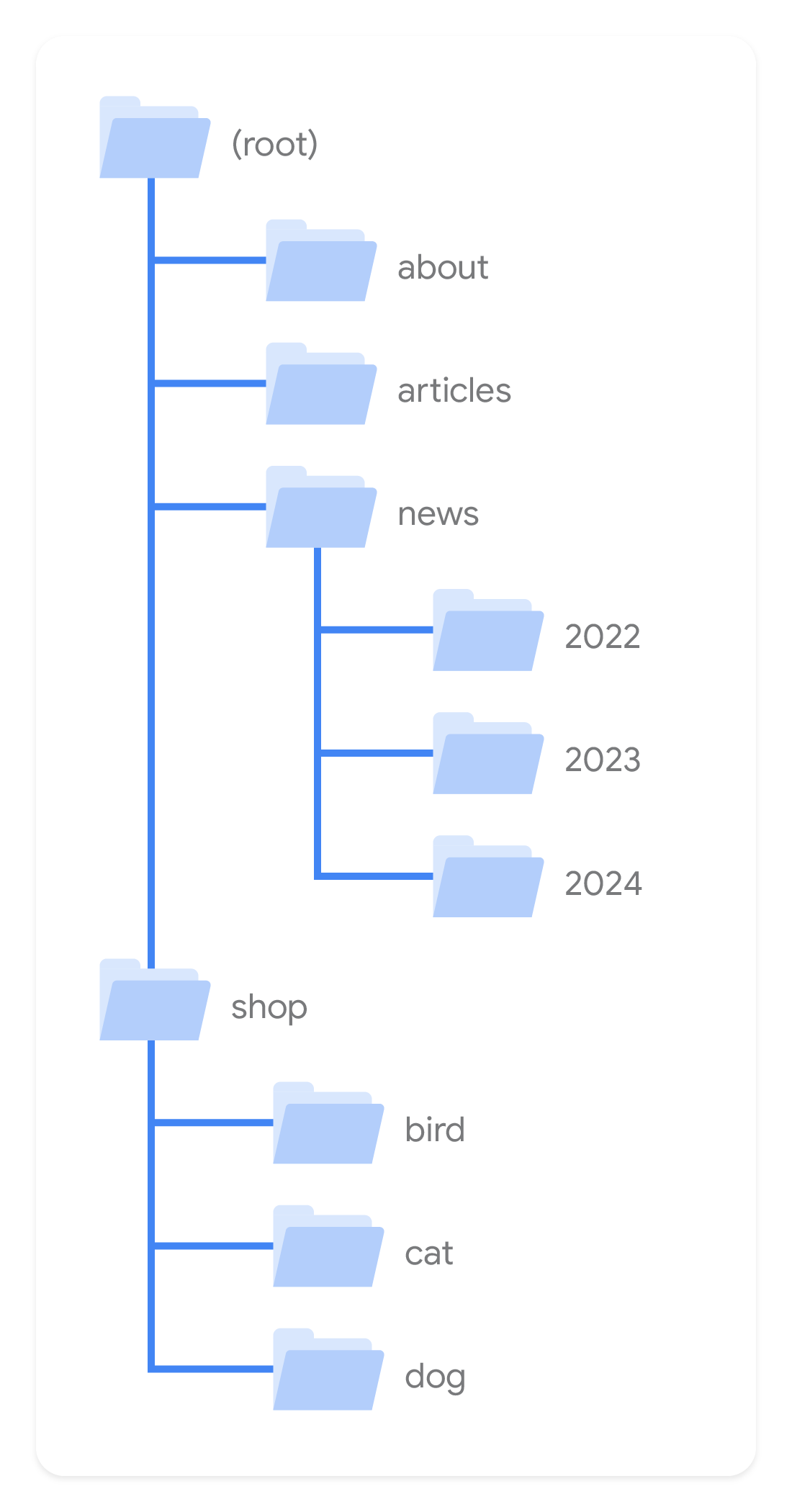
If you have more than a few thousand URLs on your site, how you organize your content may have effects on how Google crawls and indexes your site. Specifically, using directories (or folders) to group similar topics can help Google learn how often the URLs in individual directories change.
The content in the policies directory seldomly changes, however the content in the promotions directory likely changes very often. Google can learn this information and crawl the different directories at different frequencies. To learn more about search-friendly site structures, check out our guide for ecommerce sites, for which a good URL structure is more important as they tend to be larger.
Reduce duplicate content
Some websites show the same content under different URLs, which is called duplicate content. Search engines choose a single URL (the canonical URL) to show users, per piece of content.
Having duplicate content on your site is not a violation of our spam policies, but it can be a bad user experience and search engines might waste crawling resources on URLs that you don’t even care about. If you’re feeling adventurous, it’s worth figuring out if you can specify a canonical version for your pages. But if you don’t canonicalize your URLs yourself, Google will try to automatically do it for you.
When working on canonicalization, try to ensure that each piece of content on your site is only accessible through one individual URL; having two pages that contain the same information about your promotions can be a confusing user experience (for example, people might wonder which is the right page, and whether there’s a difference between the two).
If you have multiple pages that have the same information, try setting up a redirect from non-preferred URLs to a URL that best represents that information. If you can’t redirect, use the rel="canonical"link element instead. But again, don’t worry too much about this; search engines can generally figure this out for you on their own most of the time.
Make your site interesting and useful
Creating content that people find compelling and useful will likely influence your website’s presence in search results more than any of the other suggestions in this guide. While “compelling and useful content” can mean different things to different people, content like this generally shares some common attributes, such as:
The text is easy-to-read and well organized: Write content naturally and make sure the content is well written, easy to follow, and free of spelling and grammatical mistakes. Break up long content into paragraphs and sections, and provide headings to help users navigate your pages.
The content is unique: When you’re writing new content, don’t copy others’ content in part or in its entirety: create the content yourself based on what you know about the topic. Don’t just rehash what others already published.
The content is up-to-date: Check in on previously published content and update it as needed, or even delete it if it’s not relevant anymore.
The content is helpful, reliable, and people-first: Be sure that you’re writing content that your readers will find helpful and reliable. For example, providing expert or experienced sources can help people understand your articles’ expertise.
Expect your readers’ search terms
Think about the words that a user might search for to find a piece of your content. Users who know a lot about the topic might use different keywords in their search queries than someone who is new to the topic. For example, some users might search for “charcuterie”, while others might search for “cheese board”. Anticipating these differences in search behavior and writing with your readers in mind could produce positive effects on how your site performs in search results.
However, don’t worry if you don’t anticipate every variation of how someone might seek your content. Google’s language matching systems are sophisticated and can understand how your page relates to many queries, even if you don’t explicitly use the exact terms in them.
Avoid distracting advertisements
While ads are a part of the internet and are meant to be seen by users, don’t let them become overly distracting or prevent your users from reading your content. For example, advertisements, or interstitial pages (pages displayed before or after the content you’re expecting) that make it difficult to use the website.
Link to relevant resources
Links are a great way to connect your users and search engines to other parts of your site, or relevant pages on other sites. In fact, the vast majority of the new pages Google finds every day are through links, making links a crucial resource you need to consider to help your pages be discovered by Google and potentially shown in search results. Additionally, links can also add value by connecting users (and Google) to another resource that corroborates what you’re writing about.
Write good link text
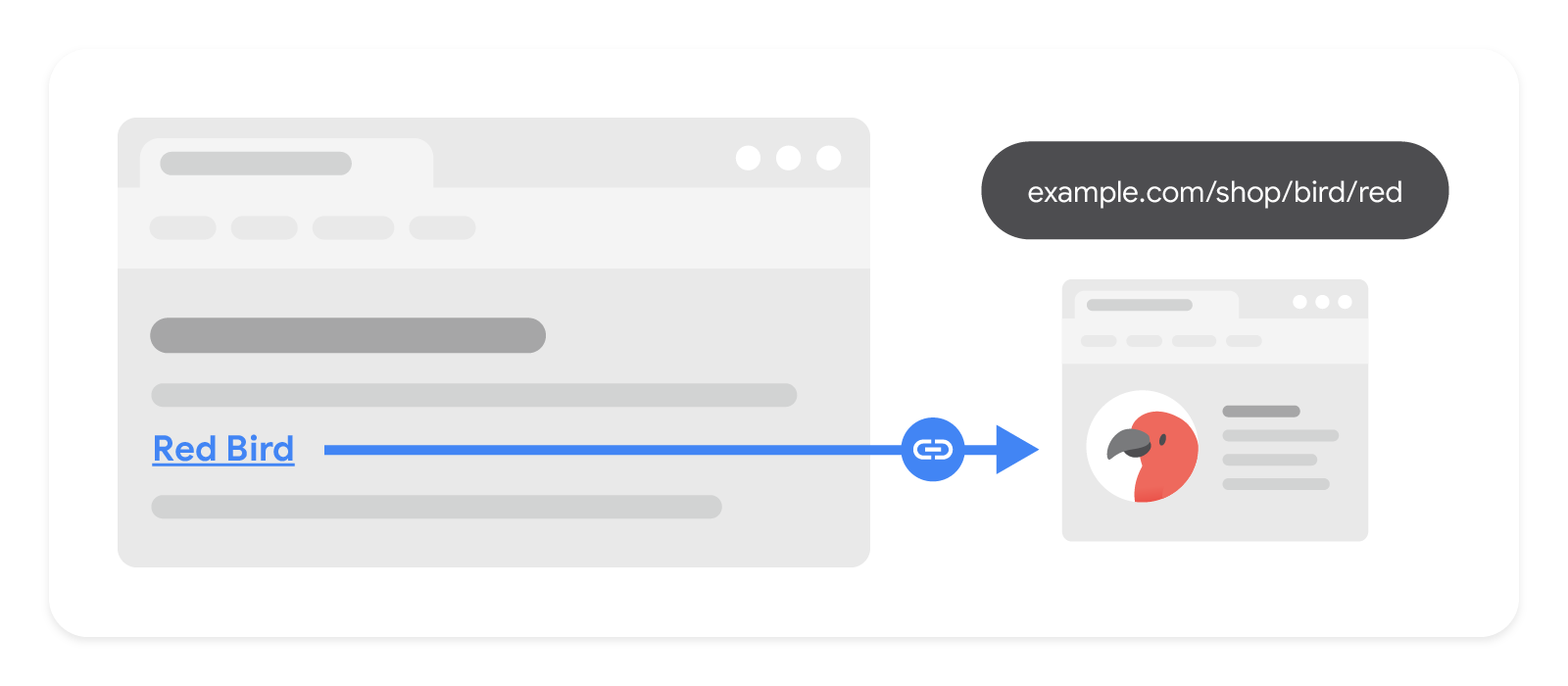
Link text (also known as anchor text) is the text part of a link that you can see. This text tells users and Google something about the page you’re linking to. With appropriate anchor text, users and search engines can easily understand what your linked pages contain before they visit.
Link when you need to
Links can provide more context on a topic, both for users and search engines, which may help demonstrate your knowledge on a topic. However when you’re linking to pages outside of your control, for example content on other sites, make sure you trust the resource you’re linking to. If you can’t trust the content and you still want to link to them, add a nofollow or similar annotation to the link to avoid search engines associating your site with the site you’re linking to. This helps avoid potential negative consequences in your rankings in Google Search.
If you’re accepting user-generated content on your site, such as forum posts or comments, make sure every link that’s posted by users has a nofollow or similar annotation automatically added by your CMS. Since you’re not creating the content in this case, you likely don’t want your site to be blindly associated with the sites users are linking to. This can also help discourage spammers from abusing your website.
Influence how your site looks in Google Search
A typical Google Search results page consists of a few different visual elements that you can influence to help users decide whether they should visit your site through those search results. In this section, we’re focusing on the title link and the snippet because these are the more visually significant elements.
Influence your title links
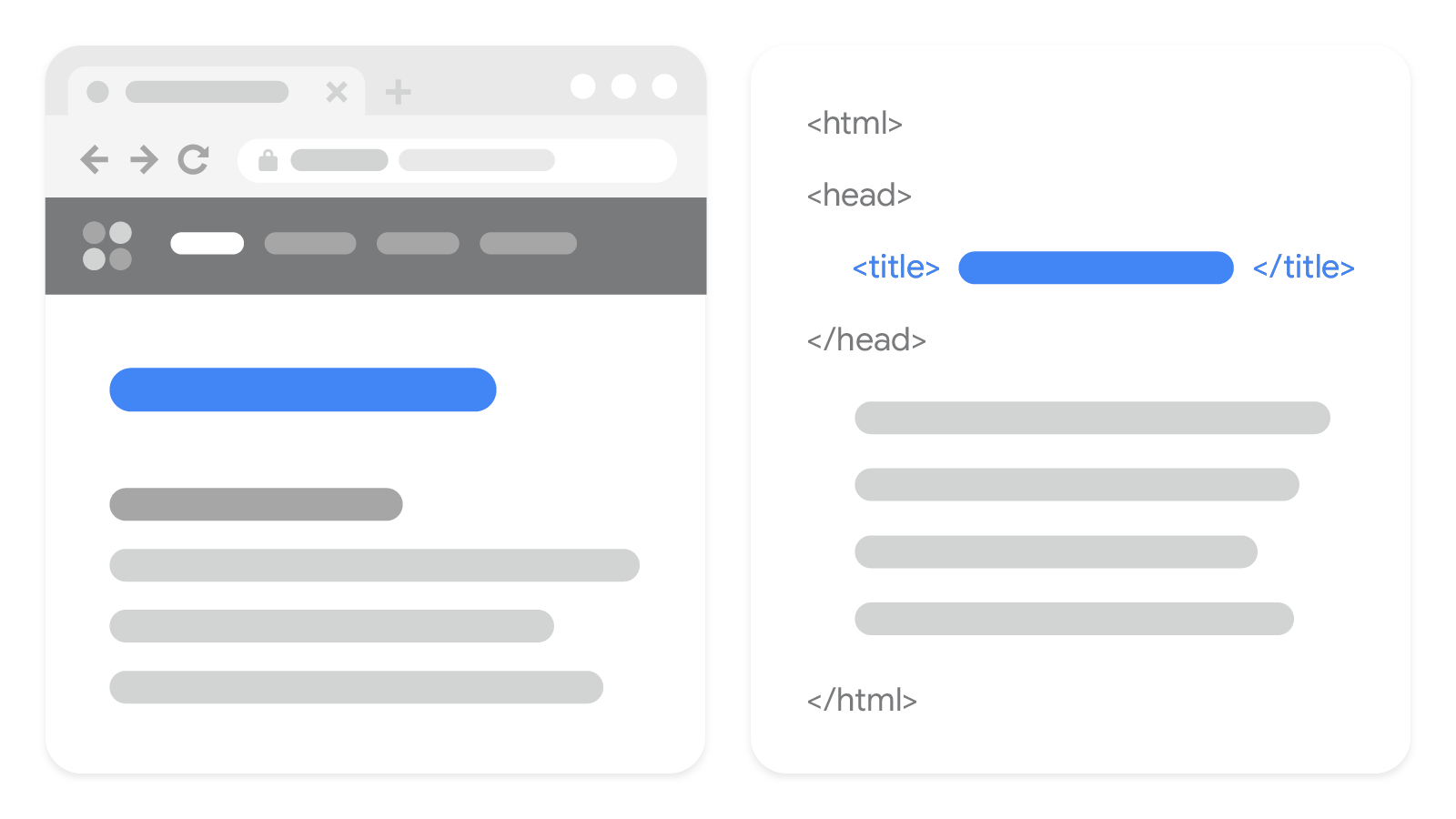
The title link is the headline part of the search result and it can help people decide which search result to click. There are a few sources that Google uses to generate this title link, including the words inside the <title> element (also called the title text) and other headings on the page. This title text can also be used for the title that’s shown in browsers and bookmarks.
You can influence the title links in Search by writing good titles: a good title is unique to the page, clear and concise, and accurately describes the contents of the page. For example, your title could include the name of your website or business, other bits of important information like the physical location of the business, and maybe some information about what the particular page has to offer for users. Our documentation about title links has more tips about how to create good titles and how to influence your site’s search results’ title links.
Control your snippets
Below the title link, a search result typically has a description of the target page to help users decide whether they should click the search result. This is called a snippet.
Learn how to cook eggs with this complete guide in less than 5 minutes. We cover all the methods, including sunny side up, boiled, and poached.
The snippet is sourced from the actual content of the page the search result is linking to, thus you have complete control over the words that can be used to generate the snippet. Occasionally the snippet may be sourced from the contents of the meta description tag, which is typically a succinct, one- or two-sentence summary of the page. A good meta description is short, unique to one particular page, and includes the most relevant points of the page. Check out our tips for writing good meta descriptions for more inspiration.
Add images to your site, and optimize them
Many people search visually, and images can be how people find your website for the first time. For example, if you have a recipe blog, people might find your content by searching for “fruit tart recipes” and browsing photos of various types of fruit tarts.
As you add images to your site, make sure that people and search engines can find and understand them.
Add high-quality images near relevant text
When you use high quality images, you give users enough context and detail to decide which image best matches what they were looking for. For example, if people are looking for “daisies” and come across a rogue edelweiss in search results, a higher quality image would help them distinguish the type of flower.
Use images that are sharp and clear, and place them near text that’s relevant to the image. The text that’s near images can help Google better understand what the image is about and what it means in context to your page.
For example, if the page is reviewing yarn shops in London, then it would make sense to embed one of your photos of the yarn shop in the section that details the location, description, and review information for that yarn shop. This helps Google and users associate the image with text that provides more context to what the page is about.
Add descriptive alt text to the image
Alt text is a short, but descriptive piece of text that explains the relationship between the image and your content. It helps search engines understand what your image is about and the context of how your image relates to your page, so writing good alt text is quite important. You can add this to your HTML with the alt attribute of the img element, or your CMS may have an easy way to specify a description for an image when you’re uploading it to your site. Learn more about how to write good alt text, and how to add it to your images.
Optimize your videos
If your website includes pages that are primarily about individual videos, people may also be able to discover your site through video results in Google Search. Many of the best practices for images and text also apply to videos:
Create high-quality video content, and embed the video on a standalone page, near text that’s relevant to that video.
Write descriptive text in the titles and description fields of a video (the title of a video is still a title, and so you can apply the best practices for writing titles here too).
Effectively promoting your new content will lead to faster discovery by those who are interested in the same subject, and also by search engines. You can do this in many ways:
Social media promotion
Community engagement
Advertisement, both offline and online
Word of mouth, and many other methods
One of the most effective and lasting ways is word of mouth: that is, people familiar with your site tell their friends about it, who in turn visit your site. This can take time, and usually you need to invest some time and effort in other practices first, such as community engagement. Our friends over at Google for Creators have excellent resources about building and engaging your audience.
Putting effort into the offline promotion of your company or site can also be rewarding. For example, if you have a business site, make sure its URL is listed on your business cards, letterhead, posters, and other materials. With their permission, you could also send out recurring newsletters to your audience letting them know about new content on your website.
As with everything in life, you can overdo promoting your site and actually harm it: people may get fatigued of your promotions, and search engines may perceive some of the practices as manipulation of search results.
Things we believe you shouldn’t focus on
As SEO has evolved, so have the ideas and practices (and at times, misconceptions) related to it. What was considered best practice or top priority in the past may no longer be relevant or effective due to the way search engines (and the internet) have developed over time.
To help you focus on the things that are actually important when it comes to SEO, we collected some of the most common and prominent topics we’ve seen circulating the internet. In general, our message on these topics is that you should do what’s best for your business area; we will elaborate on a few specific points here:
When picking the name of your site, do what’s best for your business. Users will use this name to find you, so we recommend following general marketing best practices. From a ranking perspective, the keywords in the name of the domain (or URL path) alone have hardly any effect beyond appearing in breadcrumbs.
And while still on the topic of domain names: the TLD (the domain name ending like “.com” or “.guru”) only matters if you’re targeting a specific country’s users, and even then it’s usually a low impact signal. For example, if you’re trying to sell Dutch cheese to people searching from Switzerland, it makes some sense (both from business and SEO point of view) to use a .ch domain name. Otherwise Google Search doesn’t care which TLD you’re using (whether it’s a .com or .org or .asia).
Minimum or maximum content length
The length of the content alone doesn’t matter for ranking purposes (there’s no magical word count target, minimum or maximum, though you probably want to have at least one word). If you are varying the words (writing naturally to not be repetitive), you have more chances to show up in Search simply because you are using more keywords.
Subdomains versus subdirectories
From a business point of view, do whatever makes sense for your business. For example, it might be easier to manage the site if it’s segmented by subdirectories, but other times it might make sense to partition topics into subdomains, depending on your site’s topic or industry.
PageRank
While PageRank uses links and is one of the fundamental algorithms at Google, there’s much more to Google Search than just links. We have many ranking signals, and PageRank is just one of those.
Duplicate content “penalty”
If you have some content that’s accessible under multiple URLs, it’s fine; don’t fret about it. It’s inefficient, but it’s not something that will cause a manual action. Copying others’ content, however, is a different story.
Number and order of headings
Having your headings in semantic order is fantastic for screen readers, but from Google Search perspective, it doesn’t matter if you’re using them out of order. The web in general is not valid HTML, so Google Search can rarely depend on semantic meanings hidden in the HTML specification.
There’s also no magical, ideal amount of headings a given page should have. However, if you think it’s too much, then it probably is.
Maintain your website’s SEO over time: Learn more about managing your site’s presence in the long term, including more in-depth SEO tasks and scenarios, such as preparing for a site move, or managing a multi-lingual site.
Enhance how your site looks in Google Search results: Valid structured data on your pages also makes your pages eligible for many special features in Google Search results, including review stars, carousels, and more. Explore the gallery of search result types that your page can be eligible for.
When you built your website, you likely created it with your users in mind, trying to make it easy for them to find and explore your content. One of those users is a search engine, which helps people discover your content. SEO—short for search engine optimization—is about helping search engines understand your content, and helping users find your site and make a decision about whether they should visit your site through a search engine.
The Search Essentials outline the most important elements of what makes your website eligible to appear on Google Search. While there’s no guarantee that any particular site will be added to Google’s index, sites that follow the Search Essentials are more likely to show up in Google’s search results. SEO is about taking the next step and working on improving your site’s presence in Search. This guide will walk you through some of the most common and effective improvements you can do on your site.
There are no secrets here that’ll automatically rank your site first in Google (sorry!). In fact some of the suggestions might not even apply to your business, but following the best practices will hopefully make it easier for search engines (not just Google) to crawl, index, and understand your content.
How does Google Search work?
Google is a fully automated search engine that uses programs called crawlers to explore the web constantly, looking for pages to add to our index. You usually don’t need to do anything except publish your site on the web. In fact, the vast majority of sites listed in our results are found and added automatically as we crawl the web. If you’re hungry for more, we have documentation about how Google discovers, crawls, and serves web pages.
How long until I see impact in search results?
Every change you make will take some time to be reflected on Google’s end. Some changes might take effect in a few hours, others could take several months. In general, you likely want to wait a few weeks to assess whether your work had beneficial effects in Google Search results. Keep in mind that not all changes you make to your website will result in noticeable impact in search results; if you’re not satisfied with your results and your business strategies allow it, try iterating with the changes and see if they make a difference.
Help Google find your content
Before you actually do anything mentioned in this section, check if Google has already found your content (maybe you don’t need to do anything!). Try searching on Google for your site with the site: search operator. If you see results pointing to your site, you’re in the index. For example, a search for site:wikipedia.org returns these results. If you don’t see your site, check out the technical requirements to make sure there’s nothing technically preventing your site from showing in Google Search, and then come back here.
Google primarily finds pages through links from other pages it already crawled. In many cases, these are other websites that are linking to your pages. Other sites linking to you is something that happens naturally over time, and you can also encourage people to discover your content by promoting your site.
If you’re open to a little technical challenge, you could also submit a sitemap—which is a file that contains all the URLs on your site that you care about. Some content management systems (CMS) may even do this automatically for you. However this isn’t required, and you should first focus on making sure people know about your site.
Check if Google can see your page the same way a user does
When Google crawls a page, it should ideally see the page the same way an average user does. For this, Google needs to be able to access the same resources as the user’s browser. If your site is hiding important components that make up your website (like CSS and JavaScript), Google might not be able to understand your pages, which means they might not show up in search results or rank well for the terms you’re targeting.
If your pages have different information depending on the user’s physical location, make sure you’re satisfied with the information that Google sees from its crawler’s location, which is generally the US.
It might be important for you to opt out your site as a whole or sections of it from appearing in search results. For example, you might not want your posts about your new embarrassing haircut to show up in search results. Google supports various ways that lets you opt out of crawling and indexing of your URLs. If you need to block some files, directories, or even your whole site from Google Search, check out our guide about ways to prevent content from appearing in search results.
Organize your site
When you’re setting up or redoing your site, it can be good to organize it in a logical way because it can help search engines and users understand how your pages relate to the rest of your site. Don’t drop everything and start reorganizing your site right now though: while these suggestions can be helpful long term (especially if you’re working on a larger website), search engines will likely understand your pages as they are right now, regardless of how your site is organized.
Use descriptive URLs
Parts of the URL can be displayed in search results as breadcrumbs, so users can also use the URLs to understand whether a result will be useful for them.
Google learns breadcrumbs automatically based on the words in the URL, but you can also influence them with structured data if you like a technical challenge. Try to include words in the URL that may be useful for users; for example:
https://www.example.com/pets/cats.html
A URL that only contains random identifiers is less helpful for users; for example:
https://www.example.com/2/6772756D707920636174
Group topically similar pages in directories
If you have more than a few thousand URLs on your site, how you organize your content may have effects on how Google crawls and indexes your site. Specifically, using directories (or folders) to group similar topics can help Google learn how often the URLs in individual directories change.
The content in the policies directory seldomly changes, however the content in the promotions directory likely changes very often. Google can learn this information and crawl the different directories at different frequencies. To learn more about search-friendly site structures, check out our guide for ecommerce sites, for which a good URL structure is more important as they tend to be larger.
Reduce duplicate content
Some websites show the same content under different URLs, which is called duplicate content. Search engines choose a single URL (the canonical URL) to show users, per piece of content.
Having duplicate content on your site is not a violation of our spam policies, but it can be a bad user experience and search engines might waste crawling resources on URLs that you don’t even care about. If you’re feeling adventurous, it’s worth figuring out if you can specify a canonical version for your pages. But if you don’t canonicalize your URLs yourself, Google will try to automatically do it for you.
When working on canonicalization, try to ensure that each piece of content on your site is only accessible through one individual URL; having two pages that contain the same information about your promotions can be a confusing user experience (for example, people might wonder which is the right page, and whether there’s a difference between the two).
If you have multiple pages that have the same information, try setting up a redirect from non-preferred URLs to a URL that best represents that information. If you can’t redirect, use the rel="canonical"link element instead. But again, don’t worry too much about this; search engines can generally figure this out for you on their own most of the time.
Make your site interesting and useful
Creating content that people find compelling and useful will likely influence your website’s presence in search results more than any of the other suggestions in this guide. While “compelling and useful content” can mean different things to different people, content like this generally shares some common attributes, such as:
The text is easy-to-read and well organized: Write content naturally and make sure the content is well written, easy to follow, and free of spelling and grammatical mistakes. Break up long content into paragraphs and sections, and provide headings to help users navigate your pages.
The content is unique: When you’re writing new content, don’t copy others’ content in part or in its entirety: create the content yourself based on what you know about the topic. Don’t just rehash what others already published.
The content is up-to-date: Check in on previously published content and update it as needed, or even delete it if it’s not relevant anymore.
The content is helpful, reliable, and people-first: Be sure that you’re writing content that your readers will find helpful and reliable. For example, providing expert or experienced sources can help people understand your articles’ expertise.
Expect your readers’ search terms
Think about the words that a user might search for to find a piece of your content. Users who know a lot about the topic might use different keywords in their search queries than someone who is new to the topic. For example, some users might search for “charcuterie”, while others might search for “cheese board”. Anticipating these differences in search behavior and writing with your readers in mind could produce positive effects on how your site performs in search results.
However, don’t worry if you don’t anticipate every variation of how someone might seek your content. Google’s language matching systems are sophisticated and can understand how your page relates to many queries, even if you don’t explicitly use the exact terms in them.
Avoid distracting advertisements
While ads are a part of the internet and are meant to be seen by users, don’t let them become overly distracting or prevent your users from reading your content. For example, advertisements, or interstitial pages (pages displayed before or after the content you’re expecting) that make it difficult to use the website.
Link to relevant resources
Links are a great way to connect your users and search engines to other parts of your site, or relevant pages on other sites. In fact, the vast majority of the new pages Google finds every day are through links, making links a crucial resource you need to consider to help your pages be discovered by Google and potentially shown in search results. Additionally, links can also add value by connecting users (and Google) to another resource that corroborates what you’re writing about.
Write good link text
Link text (also known as anchor text) is the text part of a link that you can see. This text tells users and Google something about the page you’re linking to. With appropriate anchor text, users and search engines can easily understand what your linked pages contain before they visit.
Link when you need to
Links can provide more context on a topic, both for users and search engines, which may help demonstrate your knowledge on a topic. However when you’re linking to pages outside of your control, for example content on other sites, make sure you trust the resource you’re linking to. If you can’t trust the content and you still want to link to them, add a nofollow or similar annotation to the link to avoid search engines associating your site with the site you’re linking to. This helps avoid potential negative consequences in your rankings in Google Search.
If you’re accepting user-generated content on your site, such as forum posts or comments, make sure every link that’s posted by users has a nofollow or similar annotation automatically added by your CMS. Since you’re not creating the content in this case, you likely don’t want your site to be blindly associated with the sites users are linking to. This can also help discourage spammers from abusing your website.
Influence how your site looks in Google Search
A typical Google Search results page consists of a few different visual elements that you can influence to help users decide whether they should visit your site through those search results. In this section, we’re focusing on the title link and the snippet because these are the more visually significant elements.
Influence your title links
The title link is the headline part of the search result and it can help people decide which search result to click. There are a few sources that Google uses to generate this title link, including the words inside the <title> element (also called the title text) and other headings on the page. This title text can also be used for the title that’s shown in browsers and bookmarks.
You can influence the title links in Search by writing good titles: a good title is unique to the page, clear and concise, and accurately describes the contents of the page. For example, your title could include the name of your website or business, other bits of important information like the physical location of the business, and maybe some information about what the particular page has to offer for users. Our documentation about title links has more tips about how to create good titles and how to influence your site’s search results’ title links.
Control your snippets
Below the title link, a search result typically has a description of the target page to help users decide whether they should click the search result. This is called a snippet.
Learn how to cook eggs with this complete guide in less than 5 minutes. We cover all the methods, including sunny side up, boiled, and poached.
The snippet is sourced from the actual content of the page the search result is linking to, thus you have complete control over the words that can be used to generate the snippet. Occasionally the snippet may be sourced from the contents of the meta description tag, which is typically a succinct, one- or two-sentence summary of the page. A good meta description is short, unique to one particular page, and includes the most relevant points of the page. Check out our tips for writing good meta descriptions for more inspiration.
Add images to your site, and optimize them
Many people search visually, and images can be how people find your website for the first time. For example, if you have a recipe blog, people might find your content by searching for “fruit tart recipes” and browsing photos of various types of fruit tarts.
As you add images to your site, make sure that people and search engines can find and understand them.
Add high-quality images near relevant text
When you use high quality images, you give users enough context and detail to decide which image best matches what they were looking for. For example, if people are looking for “daisies” and come across a rogue edelweiss in search results, a higher quality image would help them distinguish the type of flower.
Use images that are sharp and clear, and place them near text that’s relevant to the image. The text that’s near images can help Google better understand what the image is about and what it means in context to your page.
For example, if the page is reviewing yarn shops in London, then it would make sense to embed one of your photos of the yarn shop in the section that details the location, description, and review information for that yarn shop. This helps Google and users associate the image with text that provides more context to what the page is about.
Add descriptive alt text to the image
Alt text is a short, but descriptive piece of text that explains the relationship between the image and your content. It helps search engines understand what your image is about and the context of how your image relates to your page, so writing good alt text is quite important. You can add this to your HTML with the alt attribute of the img element, or your CMS may have an easy way to specify a description for an image when you’re uploading it to your site. Learn more about how to write good alt text, and how to add it to your images.
Optimize your videos
If your website includes pages that are primarily about individual videos, people may also be able to discover your site through video results in Google Search. Many of the best practices for images and text also apply to videos:
Create high-quality video content, and embed the video on a standalone page, near text that’s relevant to that video.
Write descriptive text in the titles and description fields of a video (the title of a video is still a title, and so you can apply the best practices for writing titles here too).
Effectively promoting your new content will lead to faster discovery by those who are interested in the same subject, and also by search engines. You can do this in many ways:
Social media promotion
Community engagement
Advertisement, both offline and online
Word of mouth, and many other methods
One of the most effective and lasting ways is word of mouth: that is, people familiar with your site tell their friends about it, who in turn visit your site. This can take time, and usually you need to invest some time and effort in other practices first, such as community engagement. Our friends over at Google for Creators have excellent resources about building and engaging your audience.
Putting effort into the offline promotion of your company or site can also be rewarding. For example, if you have a business site, make sure its URL is listed on your business cards, letterhead, posters, and other materials. With their permission, you could also send out recurring newsletters to your audience letting them know about new content on your website.
As with everything in life, you can overdo promoting your site and actually harm it: people may get fatigued of your promotions, and search engines may perceive some of the practices as manipulation of search results.
Things we believe you shouldn’t focus on
As SEO has evolved, so have the ideas and practices (and at times, misconceptions) related to it. What was considered best practice or top priority in the past may no longer be relevant or effective due to the way search engines (and the internet) have developed over time.
To help you focus on the things that are actually important when it comes to SEO, we collected some of the most common and prominent topics we’ve seen circulating the internet. In general, our message on these topics is that you should do what’s best for your business area; we will elaborate on a few specific points here:
When picking the name of your site, do what’s best for your business. Users will use this name to find you, so we recommend following general marketing best practices. From a ranking perspective, the keywords in the name of the domain (or URL path) alone have hardly any effect beyond appearing in breadcrumbs.
And while still on the topic of domain names: the TLD (the domain name ending like “.com” or “.guru”) only matters if you’re targeting a specific country’s users, and even then it’s usually a low impact signal. For example, if you’re trying to sell Dutch cheese to people searching from Switzerland, it makes some sense (both from business and SEO point of view) to use a .ch domain name. Otherwise Google Search doesn’t care which TLD you’re using (whether it’s a .com or .org or .asia).
Minimum or maximum content length
The length of the content alone doesn’t matter for ranking purposes (there’s no magical word count target, minimum or maximum, though you probably want to have at least one word). If you are varying the words (writing naturally to not be repetitive), you have more chances to show up in Search simply because you are using more keywords.
Subdomains versus subdirectories
From a business point of view, do whatever makes sense for your business. For example, it might be easier to manage the site if it’s segmented by subdirectories, but other times it might make sense to partition topics into subdomains, depending on your site’s topic or industry.
PageRank
While PageRank uses links and is one of the fundamental algorithms at Google, there’s much more to Google Search than just links. We have many ranking signals, and PageRank is just one of those.
Duplicate content “penalty”
If you have some content that’s accessible under multiple URLs, it’s fine; don’t fret about it. It’s inefficient, but it’s not something that will cause a manual action. Copying others’ content, however, is a different story.
Number and order of headings
Having your headings in semantic order is fantastic for screen readers, but from Google Search perspective, it doesn’t matter if you’re using them out of order. The web in general is not valid HTML, so Google Search can rarely depend on semantic meanings hidden in the HTML specification.
There’s also no magical, ideal amount of headings a given page should have. However, if you think it’s too much, then it probably is.
Maintain your website’s SEO over time: Learn more about managing your site’s presence in the long term, including more in-depth SEO tasks and scenarios, such as preparing for a site move, or managing a multi-lingual site.
Enhance how your site looks in Google Search results: Valid structured data on your pages also makes your pages eligible for many special features in Google Search results, including review stars, carousels, and more. Explore the gallery of search result types that your page can be eligible for.
When you built your website, you likely created it with your users in mind, trying to make it easy for them to find and explore your content. One of those users is a search engine, which helps people discover your content. SEO—short for search engine optimization—is about helping search engines understand your content, and helping users find your site and make a decision about whether they should visit your site through a search engine.
The Search Essentials outline the most important elements of what makes your website eligible to appear on Google Search. While there’s no guarantee that any particular site will be added to Google’s index, sites that follow the Search Essentials are more likely to show up in Google’s search results. SEO is about taking the next step and working on improving your site’s presence in Search. This guide will walk you through some of the most common and effective improvements you can do on your site.
There are no secrets here that’ll automatically rank your site first in Google (sorry!). In fact some of the suggestions might not even apply to your business, but following the best practices will hopefully make it easier for search engines (not just Google) to crawl, index, and understand your content.
How does Google Search work?
Google is a fully automated search engine that uses programs called crawlers to explore the web constantly, looking for pages to add to our index. You usually don’t need to do anything except publish your site on the web. In fact, the vast majority of sites listed in our results are found and added automatically as we crawl the web. If you’re hungry for more, we have documentation about how Google discovers, crawls, and serves web pages.
How long until I see impact in search results?
Every change you make will take some time to be reflected on Google’s end. Some changes might take effect in a few hours, others could take several months. In general, you likely want to wait a few weeks to assess whether your work had beneficial effects in Google Search results. Keep in mind that not all changes you make to your website will result in noticeable impact in search results; if you’re not satisfied with your results and your business strategies allow it, try iterating with the changes and see if they make a difference.
Help Google find your content
Before you actually do anything mentioned in this section, check if Google has already found your content (maybe you don’t need to do anything!). Try searching on Google for your site with the site: search operator. If you see results pointing to your site, you’re in the index. For example, a search for site:wikipedia.org returns these results. If you don’t see your site, check out the technical requirements to make sure there’s nothing technically preventing your site from showing in Google Search, and then come back here.
Google primarily finds pages through links from other pages it already crawled. In many cases, these are other websites that are linking to your pages. Other sites linking to you is something that happens naturally over time, and you can also encourage people to discover your content by promoting your site.
If you’re open to a little technical challenge, you could also submit a sitemap—which is a file that contains all the URLs on your site that you care about. Some content management systems (CMS) may even do this automatically for you. However this isn’t required, and you should first focus on making sure people know about your site.
Check if Google can see your page the same way a user does
When Google crawls a page, it should ideally see the page the same way an average user does. For this, Google needs to be able to access the same resources as the user’s browser. If your site is hiding important components that make up your website (like CSS and JavaScript), Google might not be able to understand your pages, which means they might not show up in search results or rank well for the terms you’re targeting.
If your pages have different information depending on the user’s physical location, make sure you’re satisfied with the information that Google sees from its crawler’s location, which is generally the US.
It might be important for you to opt out your site as a whole or sections of it from appearing in search results. For example, you might not want your posts about your new embarrassing haircut to show up in search results. Google supports various ways that lets you opt out of crawling and indexing of your URLs. If you need to block some files, directories, or even your whole site from Google Search, check out our guide about ways to prevent content from appearing in search results.
Organize your site
When you’re setting up or redoing your site, it can be good to organize it in a logical way because it can help search engines and users understand how your pages relate to the rest of your site. Don’t drop everything and start reorganizing your site right now though: while these suggestions can be helpful long term (especially if you’re working on a larger website), search engines will likely understand your pages as they are right now, regardless of how your site is organized.
Use descriptive URLs
Parts of the URL can be displayed in search results as breadcrumbs, so users can also use the URLs to understand whether a result will be useful for them.
Google learns breadcrumbs automatically based on the words in the URL, but you can also influence them with structured data if you like a technical challenge. Try to include words in the URL that may be useful for users; for example:
https://www.example.com/pets/cats.html
A URL that only contains random identifiers is less helpful for users; for example:
https://www.example.com/2/6772756D707920636174
Group topically similar pages in directories
If you have more than a few thousand URLs on your site, how you organize your content may have effects on how Google crawls and indexes your site. Specifically, using directories (or folders) to group similar topics can help Google learn how often the URLs in individual directories change.
The content in the policies directory seldomly changes, however the content in the promotions directory likely changes very often. Google can learn this information and crawl the different directories at different frequencies. To learn more about search-friendly site structures, check out our guide for ecommerce sites, for which a good URL structure is more important as they tend to be larger.
Reduce duplicate content
Some websites show the same content under different URLs, which is called duplicate content. Search engines choose a single URL (the canonical URL) to show users, per piece of content.
Having duplicate content on your site is not a violation of our spam policies, but it can be a bad user experience and search engines might waste crawling resources on URLs that you don’t even care about. If you’re feeling adventurous, it’s worth figuring out if you can specify a canonical version for your pages. But if you don’t canonicalize your URLs yourself, Google will try to automatically do it for you.
When working on canonicalization, try to ensure that each piece of content on your site is only accessible through one individual URL; having two pages that contain the same information about your promotions can be a confusing user experience (for example, people might wonder which is the right page, and whether there’s a difference between the two).
If you have multiple pages that have the same information, try setting up a redirect from non-preferred URLs to a URL that best represents that information. If you can’t redirect, use the rel="canonical"link element instead. But again, don’t worry too much about this; search engines can generally figure this out for you on their own most of the time.
Make your site interesting and useful
Creating content that people find compelling and useful will likely influence your website’s presence in search results more than any of the other suggestions in this guide. While “compelling and useful content” can mean different things to different people, content like this generally shares some common attributes, such as:
The text is easy-to-read and well organized: Write content naturally and make sure the content is well written, easy to follow, and free of spelling and grammatical mistakes. Break up long content into paragraphs and sections, and provide headings to help users navigate your pages.
The content is unique: When you’re writing new content, don’t copy others’ content in part or in its entirety: create the content yourself based on what you know about the topic. Don’t just rehash what others already published.
The content is up-to-date: Check in on previously published content and update it as needed, or even delete it if it’s not relevant anymore.
The content is helpful, reliable, and people-first: Be sure that you’re writing content that your readers will find helpful and reliable. For example, providing expert or experienced sources can help people understand your articles’ expertise.
Expect your readers’ search terms
Think about the words that a user might search for to find a piece of your content. Users who know a lot about the topic might use different keywords in their search queries than someone who is new to the topic. For example, some users might search for “charcuterie”, while others might search for “cheese board”. Anticipating these differences in search behavior and writing with your readers in mind could produce positive effects on how your site performs in search results.
However, don’t worry if you don’t anticipate every variation of how someone might seek your content. Google’s language matching systems are sophisticated and can understand how your page relates to many queries, even if you don’t explicitly use the exact terms in them.
Avoid distracting advertisements
While ads are a part of the internet and are meant to be seen by users, don’t let them become overly distracting or prevent your users from reading your content. For example, advertisements, or interstitial pages (pages displayed before or after the content you’re expecting) that make it difficult to use the website.
Link to relevant resources
Links are a great way to connect your users and search engines to other parts of your site, or relevant pages on other sites. In fact, the vast majority of the new pages Google finds every day are through links, making links a crucial resource you need to consider to help your pages be discovered by Google and potentially shown in search results. Additionally, links can also add value by connecting users (and Google) to another resource that corroborates what you’re writing about.
Write good link text
Link text (also known as anchor text) is the text part of a link that you can see. This text tells users and Google something about the page you’re linking to. With appropriate anchor text, users and search engines can easily understand what your linked pages contain before they visit.
Link when you need to
Links can provide more context on a topic, both for users and search engines, which may help demonstrate your knowledge on a topic. However when you’re linking to pages outside of your control, for example content on other sites, make sure you trust the resource you’re linking to. If you can’t trust the content and you still want to link to them, add a nofollow or similar annotation to the link to avoid search engines associating your site with the site you’re linking to. This helps avoid potential negative consequences in your rankings in Google Search.
If you’re accepting user-generated content on your site, such as forum posts or comments, make sure every link that’s posted by users has a nofollow or similar annotation automatically added by your CMS. Since you’re not creating the content in this case, you likely don’t want your site to be blindly associated with the sites users are linking to. This can also help discourage spammers from abusing your website.
Influence how your site looks in Google Search
A typical Google Search results page consists of a few different visual elements that you can influence to help users decide whether they should visit your site through those search results. In this section, we’re focusing on the title link and the snippet because these are the more visually significant elements.
Influence your title links
The title link is the headline part of the search result and it can help people decide which search result to click. There are a few sources that Google uses to generate this title link, including the words inside the <title> element (also called the title text) and other headings on the page. This title text can also be used for the title that’s shown in browsers and bookmarks.
You can influence the title links in Search by writing good titles: a good title is unique to the page, clear and concise, and accurately describes the contents of the page. For example, your title could include the name of your website or business, other bits of important information like the physical location of the business, and maybe some information about what the particular page has to offer for users. Our documentation about title links has more tips about how to create good titles and how to influence your site’s search results’ title links.
Control your snippets
Below the title link, a search result typically has a description of the target page to help users decide whether they should click the search result. This is called a snippet.
Learn how to cook eggs with this complete guide in less than 5 minutes. We cover all the methods, including sunny side up, boiled, and poached.
The snippet is sourced from the actual content of the page the search result is linking to, thus you have complete control over the words that can be used to generate the snippet. Occasionally the snippet may be sourced from the contents of the meta description tag, which is typically a succinct, one- or two-sentence summary of the page. A good meta description is short, unique to one particular page, and includes the most relevant points of the page. Check out our tips for writing good meta descriptions for more inspiration.
Add images to your site, and optimize them
Many people search visually, and images can be how people find your website for the first time. For example, if you have a recipe blog, people might find your content by searching for “fruit tart recipes” and browsing photos of various types of fruit tarts.
As you add images to your site, make sure that people and search engines can find and understand them.
Add high-quality images near relevant text
When you use high quality images, you give users enough context and detail to decide which image best matches what they were looking for. For example, if people are looking for “daisies” and come across a rogue edelweiss in search results, a higher quality image would help them distinguish the type of flower.
Use images that are sharp and clear, and place them near text that’s relevant to the image. The text that’s near images can help Google better understand what the image is about and what it means in context to your page.
For example, if the page is reviewing yarn shops in London, then it would make sense to embed one of your photos of the yarn shop in the section that details the location, description, and review information for that yarn shop. This helps Google and users associate the image with text that provides more context to what the page is about.
Add descriptive alt text to the image
Alt text is a short, but descriptive piece of text that explains the relationship between the image and your content. It helps search engines understand what your image is about and the context of how your image relates to your page, so writing good alt text is quite important. You can add this to your HTML with the alt attribute of the img element, or your CMS may have an easy way to specify a description for an image when you’re uploading it to your site. Learn more about how to write good alt text, and how to add it to your images.
Optimize your videos
If your website includes pages that are primarily about individual videos, people may also be able to discover your site through video results in Google Search. Many of the best practices for images and text also apply to videos:
Create high-quality video content, and embed the video on a standalone page, near text that’s relevant to that video.
Write descriptive text in the titles and description fields of a video (the title of a video is still a title, and so you can apply the best practices for writing titles here too).
Effectively promoting your new content will lead to faster discovery by those who are interested in the same subject, and also by search engines. You can do this in many ways:
Social media promotion
Community engagement
Advertisement, both offline and online
Word of mouth, and many other methods
One of the most effective and lasting ways is word of mouth: that is, people familiar with your site tell their friends about it, who in turn visit your site. This can take time, and usually you need to invest some time and effort in other practices first, such as community engagement. Our friends over at Google for Creators have excellent resources about building and engaging your audience.
Putting effort into the offline promotion of your company or site can also be rewarding. For example, if you have a business site, make sure its URL is listed on your business cards, letterhead, posters, and other materials. With their permission, you could also send out recurring newsletters to your audience letting them know about new content on your website.
As with everything in life, you can overdo promoting your site and actually harm it: people may get fatigued of your promotions, and search engines may perceive some of the practices as manipulation of search results.
Things we believe you shouldn’t focus on
As SEO has evolved, so have the ideas and practices (and at times, misconceptions) related to it. What was considered best practice or top priority in the past may no longer be relevant or effective due to the way search engines (and the internet) have developed over time.
To help you focus on the things that are actually important when it comes to SEO, we collected some of the most common and prominent topics we’ve seen circulating the internet. In general, our message on these topics is that you should do what’s best for your business area; we will elaborate on a few specific points here:
When picking the name of your site, do what’s best for your business. Users will use this name to find you, so we recommend following general marketing best practices. From a ranking perspective, the keywords in the name of the domain (or URL path) alone have hardly any effect beyond appearing in breadcrumbs.
And while still on the topic of domain names: the TLD (the domain name ending like “.com” or “.guru”) only matters if you’re targeting a specific country’s users, and even then it’s usually a low impact signal. For example, if you’re trying to sell Dutch cheese to people searching from Switzerland, it makes some sense (both from business and SEO point of view) to use a .ch domain name. Otherwise Google Search doesn’t care which TLD you’re using (whether it’s a .com or .org or .asia).
Minimum or maximum content length
The length of the content alone doesn’t matter for ranking purposes (there’s no magical word count target, minimum or maximum, though you probably want to have at least one word). If you are varying the words (writing naturally to not be repetitive), you have more chances to show up in Search simply because you are using more keywords.
Subdomains versus subdirectories
From a business point of view, do whatever makes sense for your business. For example, it might be easier to manage the site if it’s segmented by subdirectories, but other times it might make sense to partition topics into subdomains, depending on your site’s topic or industry.
PageRank
While PageRank uses links and is one of the fundamental algorithms at Google, there’s much more to Google Search than just links. We have many ranking signals, and PageRank is just one of those.
Duplicate content “penalty”
If you have some content that’s accessible under multiple URLs, it’s fine; don’t fret about it. It’s inefficient, but it’s not something that will cause a manual action. Copying others’ content, however, is a different story.
Number and order of headings
Having your headings in semantic order is fantastic for screen readers, but from Google Search perspective, it doesn’t matter if you’re using them out of order. The web in general is not valid HTML, so Google Search can rarely depend on semantic meanings hidden in the HTML specification.
There’s also no magical, ideal amount of headings a given page should have. However, if you think it’s too much, then it probably is.
Maintain your website’s SEO over time: Learn more about managing your site’s presence in the long term, including more in-depth SEO tasks and scenarios, such as preparing for a site move, or managing a multi-lingual site.
Enhance how your site looks in Google Search results: Valid structured data on your pages also makes your pages eligible for many special features in Google Search results, including review stars, carousels, and more. Explore the gallery of search result types that your page can be eligible for.
When you built your website, you likely created it with your users in mind, trying to make it easy for them to find and explore your content. One of those users is a search engine, which helps people discover your content. SEO—short for search engine optimization—is about helping search engines understand your content, and helping users find your site and make a decision about whether they should visit your site through a search engine.
The Search Essentials outline the most important elements of what makes your website eligible to appear on Google Search. While there’s no guarantee that any particular site will be added to Google’s index, sites that follow the Search Essentials are more likely to show up in Google’s search results. SEO is about taking the next step and working on improving your site’s presence in Search. This guide will walk you through some of the most common and effective improvements you can do on your site.
There are no secrets here that’ll automatically rank your site first in Google (sorry!). In fact some of the suggestions might not even apply to your business, but following the best practices will hopefully make it easier for search engines (not just Google) to crawl, index, and understand your content.
How does Google Search work?
Google is a fully automated search engine that uses programs called crawlers to explore the web constantly, looking for pages to add to our index. You usually don’t need to do anything except publish your site on the web. In fact, the vast majority of sites listed in our results are found and added automatically as we crawl the web. If you’re hungry for more, we have documentation about how Google discovers, crawls, and serves web pages.
How long until I see impact in search results?
Every change you make will take some time to be reflected on Google’s end. Some changes might take effect in a few hours, others could take several months. In general, you likely want to wait a few weeks to assess whether your work had beneficial effects in Google Search results. Keep in mind that not all changes you make to your website will result in noticeable impact in search results; if you’re not satisfied with your results and your business strategies allow it, try iterating with the changes and see if they make a difference.
Help Google find your content
Before you actually do anything mentioned in this section, check if Google has already found your content (maybe you don’t need to do anything!). Try searching on Google for your site with the site: search operator. If you see results pointing to your site, you’re in the index. For example, a search for site:wikipedia.org returns these results. If you don’t see your site, check out the technical requirements to make sure there’s nothing technically preventing your site from showing in Google Search, and then come back here.
Google primarily finds pages through links from other pages it already crawled. In many cases, these are other websites that are linking to your pages. Other sites linking to you is something that happens naturally over time, and you can also encourage people to discover your content by promoting your site.
If you’re open to a little technical challenge, you could also submit a sitemap—which is a file that contains all the URLs on your site that you care about. Some content management systems (CMS) may even do this automatically for you. However this isn’t required, and you should first focus on making sure people know about your site.
Check if Google can see your page the same way a user does
When Google crawls a page, it should ideally see the page the same way an average user does. For this, Google needs to be able to access the same resources as the user’s browser. If your site is hiding important components that make up your website (like CSS and JavaScript), Google might not be able to understand your pages, which means they might not show up in search results or rank well for the terms you’re targeting.
If your pages have different information depending on the user’s physical location, make sure you’re satisfied with the information that Google sees from its crawler’s location, which is generally the US.
It might be important for you to opt out your site as a whole or sections of it from appearing in search results. For example, you might not want your posts about your new embarrassing haircut to show up in search results. Google supports various ways that lets you opt out of crawling and indexing of your URLs. If you need to block some files, directories, or even your whole site from Google Search, check out our guide about ways to prevent content from appearing in search results.
Organize your site
When you’re setting up or redoing your site, it can be good to organize it in a logical way because it can help search engines and users understand how your pages relate to the rest of your site. Don’t drop everything and start reorganizing your site right now though: while these suggestions can be helpful long term (especially if you’re working on a larger website), search engines will likely understand your pages as they are right now, regardless of how your site is organized.
Use descriptive URLs
Parts of the URL can be displayed in search results as breadcrumbs, so users can also use the URLs to understand whether a result will be useful for them.
Google learns breadcrumbs automatically based on the words in the URL, but you can also influence them with structured data if you like a technical challenge. Try to include words in the URL that may be useful for users; for example:
https://www.example.com/pets/cats.html
A URL that only contains random identifiers is less helpful for users; for example:
https://www.example.com/2/6772756D707920636174
Group topically similar pages in directories
If you have more than a few thousand URLs on your site, how you organize your content may have effects on how Google crawls and indexes your site. Specifically, using directories (or folders) to group similar topics can help Google learn how often the URLs in individual directories change.
The content in the policies directory seldomly changes, however the content in the promotions directory likely changes very often. Google can learn this information and crawl the different directories at different frequencies. To learn more about search-friendly site structures, check out our guide for ecommerce sites, for which a good URL structure is more important as they tend to be larger.
Reduce duplicate content
Some websites show the same content under different URLs, which is called duplicate content. Search engines choose a single URL (the canonical URL) to show users, per piece of content.
Having duplicate content on your site is not a violation of our spam policies, but it can be a bad user experience and search engines might waste crawling resources on URLs that you don’t even care about. If you’re feeling adventurous, it’s worth figuring out if you can specify a canonical version for your pages. But if you don’t canonicalize your URLs yourself, Google will try to automatically do it for you.
When working on canonicalization, try to ensure that each piece of content on your site is only accessible through one individual URL; having two pages that contain the same information about your promotions can be a confusing user experience (for example, people might wonder which is the right page, and whether there’s a difference between the two).
If you have multiple pages that have the same information, try setting up a redirect from non-preferred URLs to a URL that best represents that information. If you can’t redirect, use the rel="canonical"link element instead. But again, don’t worry too much about this; search engines can generally figure this out for you on their own most of the time.
Make your site interesting and useful
Creating content that people find compelling and useful will likely influence your website’s presence in search results more than any of the other suggestions in this guide. While “compelling and useful content” can mean different things to different people, content like this generally shares some common attributes, such as:
The text is easy-to-read and well organized: Write content naturally and make sure the content is well written, easy to follow, and free of spelling and grammatical mistakes. Break up long content into paragraphs and sections, and provide headings to help users navigate your pages.
The content is unique: When you’re writing new content, don’t copy others’ content in part or in its entirety: create the content yourself based on what you know about the topic. Don’t just rehash what others already published.
The content is up-to-date: Check in on previously published content and update it as needed, or even delete it if it’s not relevant anymore.
The content is helpful, reliable, and people-first: Be sure that you’re writing content that your readers will find helpful and reliable. For example, providing expert or experienced sources can help people understand your articles’ expertise.
Expect your readers’ search terms
Think about the words that a user might search for to find a piece of your content. Users who know a lot about the topic might use different keywords in their search queries than someone who is new to the topic. For example, some users might search for “charcuterie”, while others might search for “cheese board”. Anticipating these differences in search behavior and writing with your readers in mind could produce positive effects on how your site performs in search results.
However, don’t worry if you don’t anticipate every variation of how someone might seek your content. Google’s language matching systems are sophisticated and can understand how your page relates to many queries, even if you don’t explicitly use the exact terms in them.
Avoid distracting advertisements
While ads are a part of the internet and are meant to be seen by users, don’t let them become overly distracting or prevent your users from reading your content. For example, advertisements, or interstitial pages (pages displayed before or after the content you’re expecting) that make it difficult to use the website.
Link to relevant resources
Links are a great way to connect your users and search engines to other parts of your site, or relevant pages on other sites. In fact, the vast majority of the new pages Google finds every day are through links, making links a crucial resource you need to consider to help your pages be discovered by Google and potentially shown in search results. Additionally, links can also add value by connecting users (and Google) to another resource that corroborates what you’re writing about.
Write good link text
Link text (also known as anchor text) is the text part of a link that you can see. This text tells users and Google something about the page you’re linking to. With appropriate anchor text, users and search engines can easily understand what your linked pages contain before they visit.
Link when you need to
Links can provide more context on a topic, both for users and search engines, which may help demonstrate your knowledge on a topic. However when you’re linking to pages outside of your control, for example content on other sites, make sure you trust the resource you’re linking to. If you can’t trust the content and you still want to link to them, add a nofollow or similar annotation to the link to avoid search engines associating your site with the site you’re linking to. This helps avoid potential negative consequences in your rankings in Google Search.
If you’re accepting user-generated content on your site, such as forum posts or comments, make sure every link that’s posted by users has a nofollow or similar annotation automatically added by your CMS. Since you’re not creating the content in this case, you likely don’t want your site to be blindly associated with the sites users are linking to. This can also help discourage spammers from abusing your website.
Influence how your site looks in Google Search
A typical Google Search results page consists of a few different visual elements that you can influence to help users decide whether they should visit your site through those search results. In this section, we’re focusing on the title link and the snippet because these are the more visually significant elements.
Influence your title links
The title link is the headline part of the search result and it can help people decide which search result to click. There are a few sources that Google uses to generate this title link, including the words inside the <title> element (also called the title text) and other headings on the page. This title text can also be used for the title that’s shown in browsers and bookmarks.
You can influence the title links in Search by writing good titles: a good title is unique to the page, clear and concise, and accurately describes the contents of the page. For example, your title could include the name of your website or business, other bits of important information like the physical location of the business, and maybe some information about what the particular page has to offer for users. Our documentation about title links has more tips about how to create good titles and how to influence your site’s search results’ title links.
Control your snippets
Below the title link, a search result typically has a description of the target page to help users decide whether they should click the search result. This is called a snippet.
Learn how to cook eggs with this complete guide in less than 5 minutes. We cover all the methods, including sunny side up, boiled, and poached.
The snippet is sourced from the actual content of the page the search result is linking to, thus you have complete control over the words that can be used to generate the snippet. Occasionally the snippet may be sourced from the contents of the meta description tag, which is typically a succinct, one- or two-sentence summary of the page. A good meta description is short, unique to one particular page, and includes the most relevant points of the page. Check out our tips for writing good meta descriptions for more inspiration.
Add images to your site, and optimize them
Many people search visually, and images can be how people find your website for the first time. For example, if you have a recipe blog, people might find your content by searching for “fruit tart recipes” and browsing photos of various types of fruit tarts.
As you add images to your site, make sure that people and search engines can find and understand them.
Add high-quality images near relevant text
When you use high quality images, you give users enough context and detail to decide which image best matches what they were looking for. For example, if people are looking for “daisies” and come across a rogue edelweiss in search results, a higher quality image would help them distinguish the type of flower.
Use images that are sharp and clear, and place them near text that’s relevant to the image. The text that’s near images can help Google better understand what the image is about and what it means in context to your page.
For example, if the page is reviewing yarn shops in London, then it would make sense to embed one of your photos of the yarn shop in the section that details the location, description, and review information for that yarn shop. This helps Google and users associate the image with text that provides more context to what the page is about.
Add descriptive alt text to the image
Alt text is a short, but descriptive piece of text that explains the relationship between the image and your content. It helps search engines understand what your image is about and the context of how your image relates to your page, so writing good alt text is quite important. You can add this to your HTML with the alt attribute of the img element, or your CMS may have an easy way to specify a description for an image when you’re uploading it to your site. Learn more about how to write good alt text, and how to add it to your images.
Optimize your videos
If your website includes pages that are primarily about individual videos, people may also be able to discover your site through video results in Google Search. Many of the best practices for images and text also apply to videos:
Create high-quality video content, and embed the video on a standalone page, near text that’s relevant to that video.
Write descriptive text in the titles and description fields of a video (the title of a video is still a title, and so you can apply the best practices for writing titles here too).
Effectively promoting your new content will lead to faster discovery by those who are interested in the same subject, and also by search engines. You can do this in many ways:
Social media promotion
Community engagement
Advertisement, both offline and online
Word of mouth, and many other methods
One of the most effective and lasting ways is word of mouth: that is, people familiar with your site tell their friends about it, who in turn visit your site. This can take time, and usually you need to invest some time and effort in other practices first, such as community engagement. Our friends over at Google for Creators have excellent resources about building and engaging your audience.
Putting effort into the offline promotion of your company or site can also be rewarding. For example, if you have a business site, make sure its URL is listed on your business cards, letterhead, posters, and other materials. With their permission, you could also send out recurring newsletters to your audience letting them know about new content on your website.
As with everything in life, you can overdo promoting your site and actually harm it: people may get fatigued of your promotions, and search engines may perceive some of the practices as manipulation of search results.
Things we believe you shouldn’t focus on
As SEO has evolved, so have the ideas and practices (and at times, misconceptions) related to it. What was considered best practice or top priority in the past may no longer be relevant or effective due to the way search engines (and the internet) have developed over time.
To help you focus on the things that are actually important when it comes to SEO, we collected some of the most common and prominent topics we’ve seen circulating the internet. In general, our message on these topics is that you should do what’s best for your business area; we will elaborate on a few specific points here:
When picking the name of your site, do what’s best for your business. Users will use this name to find you, so we recommend following general marketing best practices. From a ranking perspective, the keywords in the name of the domain (or URL path) alone have hardly any effect beyond appearing in breadcrumbs.
And while still on the topic of domain names: the TLD (the domain name ending like “.com” or “.guru”) only matters if you’re targeting a specific country’s users, and even then it’s usually a low impact signal. For example, if you’re trying to sell Dutch cheese to people searching from Switzerland, it makes some sense (both from business and SEO point of view) to use a .ch domain name. Otherwise Google Search doesn’t care which TLD you’re using (whether it’s a .com or .org or .asia).
Minimum or maximum content length
The length of the content alone doesn’t matter for ranking purposes (there’s no magical word count target, minimum or maximum, though you probably want to have at least one word). If you are varying the words (writing naturally to not be repetitive), you have more chances to show up in Search simply because you are using more keywords.
Subdomains versus subdirectories
From a business point of view, do whatever makes sense for your business. For example, it might be easier to manage the site if it’s segmented by subdirectories, but other times it might make sense to partition topics into subdomains, depending on your site’s topic or industry.
PageRank
While PageRank uses links and is one of the fundamental algorithms at Google, there’s much more to Google Search than just links. We have many ranking signals, and PageRank is just one of those.
Duplicate content “penalty”
If you have some content that’s accessible under multiple URLs, it’s fine; don’t fret about it. It’s inefficient, but it’s not something that will cause a manual action. Copying others’ content, however, is a different story.
Number and order of headings
Having your headings in semantic order is fantastic for screen readers, but from Google Search perspective, it doesn’t matter if you’re using them out of order. The web in general is not valid HTML, so Google Search can rarely depend on semantic meanings hidden in the HTML specification.
There’s also no magical, ideal amount of headings a given page should have. However, if you think it’s too much, then it probably is.
Maintain your website’s SEO over time: Learn more about managing your site’s presence in the long term, including more in-depth SEO tasks and scenarios, such as preparing for a site move, or managing a multi-lingual site.
Enhance how your site looks in Google Search results: Valid structured data on your pages also makes your pages eligible for many special features in Google Search results, including review stars, carousels, and more. Explore the gallery of search result types that your page can be eligible for.
When you built your website, you likely created it with your users in mind, trying to make it easy for them to find and explore your content. One of those users is a search engine, which helps people discover your content. SEO—short for search engine optimization—is about helping search engines understand your content, and helping users find your site and make a decision about whether they should visit your site through a search engine.
The Search Essentials outline the most important elements of what makes your website eligible to appear on Google Search. While there’s no guarantee that any particular site will be added to Google’s index, sites that follow the Search Essentials are more likely to show up in Google’s search results. SEO is about taking the next step and working on improving your site’s presence in Search. This guide will walk you through some of the most common and effective improvements you can do on your site.
There are no secrets here that’ll automatically rank your site first in Google (sorry!). In fact some of the suggestions might not even apply to your business, but following the best practices will hopefully make it easier for search engines (not just Google) to crawl, index, and understand your content.
How does Google Search work?
Google is a fully automated search engine that uses programs called crawlers to explore the web constantly, looking for pages to add to our index. You usually don’t need to do anything except publish your site on the web. In fact, the vast majority of sites listed in our results are found and added automatically as we crawl the web. If you’re hungry for more, we have documentation about how Google discovers, crawls, and serves web pages.
How long until I see impact in search results?
Every change you make will take some time to be reflected on Google’s end. Some changes might take effect in a few hours, others could take several months. In general, you likely want to wait a few weeks to assess whether your work had beneficial effects in Google Search results. Keep in mind that not all changes you make to your website will result in noticeable impact in search results; if you’re not satisfied with your results and your business strategies allow it, try iterating with the changes and see if they make a difference.
Help Google find your content
Before you actually do anything mentioned in this section, check if Google has already found your content (maybe you don’t need to do anything!). Try searching on Google for your site with the site: search operator. If you see results pointing to your site, you’re in the index. For example, a search for site:wikipedia.org returns these results. If you don’t see your site, check out the technical requirements to make sure there’s nothing technically preventing your site from showing in Google Search, and then come back here.
Google primarily finds pages through links from other pages it already crawled. In many cases, these are other websites that are linking to your pages. Other sites linking to you is something that happens naturally over time, and you can also encourage people to discover your content by promoting your site.
If you’re open to a little technical challenge, you could also submit a sitemap—which is a file that contains all the URLs on your site that you care about. Some content management systems (CMS) may even do this automatically for you. However this isn’t required, and you should first focus on making sure people know about your site.
Check if Google can see your page the same way a user does
When Google crawls a page, it should ideally see the page the same way an average user does. For this, Google needs to be able to access the same resources as the user’s browser. If your site is hiding important components that make up your website (like CSS and JavaScript), Google might not be able to understand your pages, which means they might not show up in search results or rank well for the terms you’re targeting.
If your pages have different information depending on the user’s physical location, make sure you’re satisfied with the information that Google sees from its crawler’s location, which is generally the US.
It might be important for you to opt out your site as a whole or sections of it from appearing in search results. For example, you might not want your posts about your new embarrassing haircut to show up in search results. Google supports various ways that lets you opt out of crawling and indexing of your URLs. If you need to block some files, directories, or even your whole site from Google Search, check out our guide about ways to prevent content from appearing in search results.
Organize your site
When you’re setting up or redoing your site, it can be good to organize it in a logical way because it can help search engines and users understand how your pages relate to the rest of your site. Don’t drop everything and start reorganizing your site right now though: while these suggestions can be helpful long term (especially if you’re working on a larger website), search engines will likely understand your pages as they are right now, regardless of how your site is organized.
Use descriptive URLs
Parts of the URL can be displayed in search results as breadcrumbs, so users can also use the URLs to understand whether a result will be useful for them.
Google learns breadcrumbs automatically based on the words in the URL, but you can also influence them with structured data if you like a technical challenge. Try to include words in the URL that may be useful for users; for example:
https://www.example.com/pets/cats.html
A URL that only contains random identifiers is less helpful for users; for example:
https://www.example.com/2/6772756D707920636174
Group topically similar pages in directories
If you have more than a few thousand URLs on your site, how you organize your content may have effects on how Google crawls and indexes your site. Specifically, using directories (or folders) to group similar topics can help Google learn how often the URLs in individual directories change.
The content in the policies directory seldomly changes, however the content in the promotions directory likely changes very often. Google can learn this information and crawl the different directories at different frequencies. To learn more about search-friendly site structures, check out our guide for ecommerce sites, for which a good URL structure is more important as they tend to be larger.
Reduce duplicate content
Some websites show the same content under different URLs, which is called duplicate content. Search engines choose a single URL (the canonical URL) to show users, per piece of content.
Having duplicate content on your site is not a violation of our spam policies, but it can be a bad user experience and search engines might waste crawling resources on URLs that you don’t even care about. If you’re feeling adventurous, it’s worth figuring out if you can specify a canonical version for your pages. But if you don’t canonicalize your URLs yourself, Google will try to automatically do it for you.
When working on canonicalization, try to ensure that each piece of content on your site is only accessible through one individual URL; having two pages that contain the same information about your promotions can be a confusing user experience (for example, people might wonder which is the right page, and whether there’s a difference between the two).
If you have multiple pages that have the same information, try setting up a redirect from non-preferred URLs to a URL that best represents that information. If you can’t redirect, use the rel="canonical"link element instead. But again, don’t worry too much about this; search engines can generally figure this out for you on their own most of the time.
Make your site interesting and useful
Creating content that people find compelling and useful will likely influence your website’s presence in search results more than any of the other suggestions in this guide. While “compelling and useful content” can mean different things to different people, content like this generally shares some common attributes, such as:
The text is easy-to-read and well organized: Write content naturally and make sure the content is well written, easy to follow, and free of spelling and grammatical mistakes. Break up long content into paragraphs and sections, and provide headings to help users navigate your pages.
The content is unique: When you’re writing new content, don’t copy others’ content in part or in its entirety: create the content yourself based on what you know about the topic. Don’t just rehash what others already published.
The content is up-to-date: Check in on previously published content and update it as needed, or even delete it if it’s not relevant anymore.
The content is helpful, reliable, and people-first: Be sure that you’re writing content that your readers will find helpful and reliable. For example, providing expert or experienced sources can help people understand your articles’ expertise.
Expect your readers’ search terms
Think about the words that a user might search for to find a piece of your content. Users who know a lot about the topic might use different keywords in their search queries than someone who is new to the topic. For example, some users might search for “charcuterie”, while others might search for “cheese board”. Anticipating these differences in search behavior and writing with your readers in mind could produce positive effects on how your site performs in search results.
However, don’t worry if you don’t anticipate every variation of how someone might seek your content. Google’s language matching systems are sophisticated and can understand how your page relates to many queries, even if you don’t explicitly use the exact terms in them.
Avoid distracting advertisements
While ads are a part of the internet and are meant to be seen by users, don’t let them become overly distracting or prevent your users from reading your content. For example, advertisements, or interstitial pages (pages displayed before or after the content you’re expecting) that make it difficult to use the website.
Link to relevant resources
Links are a great way to connect your users and search engines to other parts of your site, or relevant pages on other sites. In fact, the vast majority of the new pages Google finds every day are through links, making links a crucial resource you need to consider to help your pages be discovered by Google and potentially shown in search results. Additionally, links can also add value by connecting users (and Google) to another resource that corroborates what you’re writing about.
Write good link text
Link text (also known as anchor text) is the text part of a link that you can see. This text tells users and Google something about the page you’re linking to. With appropriate anchor text, users and search engines can easily understand what your linked pages contain before they visit.
Link when you need to
Links can provide more context on a topic, both for users and search engines, which may help demonstrate your knowledge on a topic. However when you’re linking to pages outside of your control, for example content on other sites, make sure you trust the resource you’re linking to. If you can’t trust the content and you still want to link to them, add a nofollow or similar annotation to the link to avoid search engines associating your site with the site you’re linking to. This helps avoid potential negative consequences in your rankings in Google Search.
If you’re accepting user-generated content on your site, such as forum posts or comments, make sure every link that’s posted by users has a nofollow or similar annotation automatically added by your CMS. Since you’re not creating the content in this case, you likely don’t want your site to be blindly associated with the sites users are linking to. This can also help discourage spammers from abusing your website.
Influence how your site looks in Google Search
A typical Google Search results page consists of a few different visual elements that you can influence to help users decide whether they should visit your site through those search results. In this section, we’re focusing on the title link and the snippet because these are the more visually significant elements.
Influence your title links
The title link is the headline part of the search result and it can help people decide which search result to click. There are a few sources that Google uses to generate this title link, including the words inside the <title> element (also called the title text) and other headings on the page. This title text can also be used for the title that’s shown in browsers and bookmarks.
You can influence the title links in Search by writing good titles: a good title is unique to the page, clear and concise, and accurately describes the contents of the page. For example, your title could include the name of your website or business, other bits of important information like the physical location of the business, and maybe some information about what the particular page has to offer for users. Our documentation about title links has more tips about how to create good titles and how to influence your site’s search results’ title links.
Control your snippets
Below the title link, a search result typically has a description of the target page to help users decide whether they should click the search result. This is called a snippet.
Learn how to cook eggs with this complete guide in less than 5 minutes. We cover all the methods, including sunny side up, boiled, and poached.
The snippet is sourced from the actual content of the page the search result is linking to, thus you have complete control over the words that can be used to generate the snippet. Occasionally the snippet may be sourced from the contents of the meta description tag, which is typically a succinct, one- or two-sentence summary of the page. A good meta description is short, unique to one particular page, and includes the most relevant points of the page. Check out our tips for writing good meta descriptions for more inspiration.
Add images to your site, and optimize them
Many people search visually, and images can be how people find your website for the first time. For example, if you have a recipe blog, people might find your content by searching for “fruit tart recipes” and browsing photos of various types of fruit tarts.
As you add images to your site, make sure that people and search engines can find and understand them.
Add high-quality images near relevant text
When you use high quality images, you give users enough context and detail to decide which image best matches what they were looking for. For example, if people are looking for “daisies” and come across a rogue edelweiss in search results, a higher quality image would help them distinguish the type of flower.
Use images that are sharp and clear, and place them near text that’s relevant to the image. The text that’s near images can help Google better understand what the image is about and what it means in context to your page.
For example, if the page is reviewing yarn shops in London, then it would make sense to embed one of your photos of the yarn shop in the section that details the location, description, and review information for that yarn shop. This helps Google and users associate the image with text that provides more context to what the page is about.
Add descriptive alt text to the image
Alt text is a short, but descriptive piece of text that explains the relationship between the image and your content. It helps search engines understand what your image is about and the context of how your image relates to your page, so writing good alt text is quite important. You can add this to your HTML with the alt attribute of the img element, or your CMS may have an easy way to specify a description for an image when you’re uploading it to your site. Learn more about how to write good alt text, and how to add it to your images.
Optimize your videos
If your website includes pages that are primarily about individual videos, people may also be able to discover your site through video results in Google Search. Many of the best practices for images and text also apply to videos:
Create high-quality video content, and embed the video on a standalone page, near text that’s relevant to that video.
Write descriptive text in the titles and description fields of a video (the title of a video is still a title, and so you can apply the best practices for writing titles here too).
Effectively promoting your new content will lead to faster discovery by those who are interested in the same subject, and also by search engines. You can do this in many ways:
Social media promotion
Community engagement
Advertisement, both offline and online
Word of mouth, and many other methods
One of the most effective and lasting ways is word of mouth: that is, people familiar with your site tell their friends about it, who in turn visit your site. This can take time, and usually you need to invest some time and effort in other practices first, such as community engagement. Our friends over at Google for Creators have excellent resources about building and engaging your audience.
Putting effort into the offline promotion of your company or site can also be rewarding. For example, if you have a business site, make sure its URL is listed on your business cards, letterhead, posters, and other materials. With their permission, you could also send out recurring newsletters to your audience letting them know about new content on your website.
As with everything in life, you can overdo promoting your site and actually harm it: people may get fatigued of your promotions, and search engines may perceive some of the practices as manipulation of search results.
Things we believe you shouldn’t focus on
As SEO has evolved, so have the ideas and practices (and at times, misconceptions) related to it. What was considered best practice or top priority in the past may no longer be relevant or effective due to the way search engines (and the internet) have developed over time.
To help you focus on the things that are actually important when it comes to SEO, we collected some of the most common and prominent topics we’ve seen circulating the internet. In general, our message on these topics is that you should do what’s best for your business area; we will elaborate on a few specific points here:
When picking the name of your site, do what’s best for your business. Users will use this name to find you, so we recommend following general marketing best practices. From a ranking perspective, the keywords in the name of the domain (or URL path) alone have hardly any effect beyond appearing in breadcrumbs.
And while still on the topic of domain names: the TLD (the domain name ending like “.com” or “.guru”) only matters if you’re targeting a specific country’s users, and even then it’s usually a low impact signal. For example, if you’re trying to sell Dutch cheese to people searching from Switzerland, it makes some sense (both from business and SEO point of view) to use a .ch domain name. Otherwise Google Search doesn’t care which TLD you’re using (whether it’s a .com or .org or .asia).
Minimum or maximum content length
The length of the content alone doesn’t matter for ranking purposes (there’s no magical word count target, minimum or maximum, though you probably want to have at least one word). If you are varying the words (writing naturally to not be repetitive), you have more chances to show up in Search simply because you are using more keywords.
Subdomains versus subdirectories
From a business point of view, do whatever makes sense for your business. For example, it might be easier to manage the site if it’s segmented by subdirectories, but other times it might make sense to partition topics into subdomains, depending on your site’s topic or industry.
PageRank
While PageRank uses links and is one of the fundamental algorithms at Google, there’s much more to Google Search than just links. We have many ranking signals, and PageRank is just one of those.
Duplicate content “penalty”
If you have some content that’s accessible under multiple URLs, it’s fine; don’t fret about it. It’s inefficient, but it’s not something that will cause a manual action. Copying others’ content, however, is a different story.
Number and order of headings
Having your headings in semantic order is fantastic for screen readers, but from Google Search perspective, it doesn’t matter if you’re using them out of order. The web in general is not valid HTML, so Google Search can rarely depend on semantic meanings hidden in the HTML specification.
There’s also no magical, ideal amount of headings a given page should have. However, if you think it’s too much, then it probably is.
Maintain your website’s SEO over time: Learn more about managing your site’s presence in the long term, including more in-depth SEO tasks and scenarios, such as preparing for a site move, or managing a multi-lingual site.
Enhance how your site looks in Google Search results: Valid structured data on your pages also makes your pages eligible for many special features in Google Search results, including review stars, carousels, and more. Explore the gallery of search result types that your page can be eligible for.
When you built your website, you likely created it with your users in mind, trying to make it easy for them to find and explore your content. One of those users is a search engine, which helps people discover your content. SEO—short for search engine optimization—is about helping search engines understand your content, and helping users find your site and make a decision about whether they should visit your site through a search engine.
The Search Essentials outline the most important elements of what makes your website eligible to appear on Google Search. While there’s no guarantee that any particular site will be added to Google’s index, sites that follow the Search Essentials are more likely to show up in Google’s search results. SEO is about taking the next step and working on improving your site’s presence in Search. This guide will walk you through some of the most common and effective improvements you can do on your site.
There are no secrets here that’ll automatically rank your site first in Google (sorry!). In fact some of the suggestions might not even apply to your business, but following the best practices will hopefully make it easier for search engines (not just Google) to crawl, index, and understand your content.
How does Google Search work?
Google is a fully automated search engine that uses programs called crawlers to explore the web constantly, looking for pages to add to our index. You usually don’t need to do anything except publish your site on the web. In fact, the vast majority of sites listed in our results are found and added automatically as we crawl the web. If you’re hungry for more, we have documentation about how Google discovers, crawls, and serves web pages.
How long until I see impact in search results?
Every change you make will take some time to be reflected on Google’s end. Some changes might take effect in a few hours, others could take several months. In general, you likely want to wait a few weeks to assess whether your work had beneficial effects in Google Search results. Keep in mind that not all changes you make to your website will result in noticeable impact in search results; if you’re not satisfied with your results and your business strategies allow it, try iterating with the changes and see if they make a difference.
Help Google find your content
Before you actually do anything mentioned in this section, check if Google has already found your content (maybe you don’t need to do anything!). Try searching on Google for your site with the site: search operator. If you see results pointing to your site, you’re in the index. For example, a search for site:wikipedia.org returns these results. If you don’t see your site, check out the technical requirements to make sure there’s nothing technically preventing your site from showing in Google Search, and then come back here.
Google primarily finds pages through links from other pages it already crawled. In many cases, these are other websites that are linking to your pages. Other sites linking to you is something that happens naturally over time, and you can also encourage people to discover your content by promoting your site.
If you’re open to a little technical challenge, you could also submit a sitemap—which is a file that contains all the URLs on your site that you care about. Some content management systems (CMS) may even do this automatically for you. However this isn’t required, and you should first focus on making sure people know about your site.
Check if Google can see your page the same way a user does
When Google crawls a page, it should ideally see the page the same way an average user does. For this, Google needs to be able to access the same resources as the user’s browser. If your site is hiding important components that make up your website (like CSS and JavaScript), Google might not be able to understand your pages, which means they might not show up in search results or rank well for the terms you’re targeting.
If your pages have different information depending on the user’s physical location, make sure you’re satisfied with the information that Google sees from its crawler’s location, which is generally the US.
It might be important for you to opt out your site as a whole or sections of it from appearing in search results. For example, you might not want your posts about your new embarrassing haircut to show up in search results. Google supports various ways that lets you opt out of crawling and indexing of your URLs. If you need to block some files, directories, or even your whole site from Google Search, check out our guide about ways to prevent content from appearing in search results.
Organize your site
When you’re setting up or redoing your site, it can be good to organize it in a logical way because it can help search engines and users understand how your pages relate to the rest of your site. Don’t drop everything and start reorganizing your site right now though: while these suggestions can be helpful long term (especially if you’re working on a larger website), search engines will likely understand your pages as they are right now, regardless of how your site is organized.
Use descriptive URLs
Parts of the URL can be displayed in search results as breadcrumbs, so users can also use the URLs to understand whether a result will be useful for them.
Google learns breadcrumbs automatically based on the words in the URL, but you can also influence them with structured data if you like a technical challenge. Try to include words in the URL that may be useful for users; for example:
https://www.example.com/pets/cats.html
A URL that only contains random identifiers is less helpful for users; for example:
https://www.example.com/2/6772756D707920636174
Group topically similar pages in directories
If you have more than a few thousand URLs on your site, how you organize your content may have effects on how Google crawls and indexes your site. Specifically, using directories (or folders) to group similar topics can help Google learn how often the URLs in individual directories change.
The content in the policies directory seldomly changes, however the content in the promotions directory likely changes very often. Google can learn this information and crawl the different directories at different frequencies. To learn more about search-friendly site structures, check out our guide for ecommerce sites, for which a good URL structure is more important as they tend to be larger.
Reduce duplicate content
Some websites show the same content under different URLs, which is called duplicate content. Search engines choose a single URL (the canonical URL) to show users, per piece of content.
Having duplicate content on your site is not a violation of our spam policies, but it can be a bad user experience and search engines might waste crawling resources on URLs that you don’t even care about. If you’re feeling adventurous, it’s worth figuring out if you can specify a canonical version for your pages. But if you don’t canonicalize your URLs yourself, Google will try to automatically do it for you.
When working on canonicalization, try to ensure that each piece of content on your site is only accessible through one individual URL; having two pages that contain the same information about your promotions can be a confusing user experience (for example, people might wonder which is the right page, and whether there’s a difference between the two).
If you have multiple pages that have the same information, try setting up a redirect from non-preferred URLs to a URL that best represents that information. If you can’t redirect, use the rel="canonical"link element instead. But again, don’t worry too much about this; search engines can generally figure this out for you on their own most of the time.
Make your site interesting and useful
Creating content that people find compelling and useful will likely influence your website’s presence in search results more than any of the other suggestions in this guide. While “compelling and useful content” can mean different things to different people, content like this generally shares some common attributes, such as:
The text is easy-to-read and well organized: Write content naturally and make sure the content is well written, easy to follow, and free of spelling and grammatical mistakes. Break up long content into paragraphs and sections, and provide headings to help users navigate your pages.
The content is unique: When you’re writing new content, don’t copy others’ content in part or in its entirety: create the content yourself based on what you know about the topic. Don’t just rehash what others already published.
The content is up-to-date: Check in on previously published content and update it as needed, or even delete it if it’s not relevant anymore.
The content is helpful, reliable, and people-first: Be sure that you’re writing content that your readers will find helpful and reliable. For example, providing expert or experienced sources can help people understand your articles’ expertise.
Expect your readers’ search terms
Think about the words that a user might search for to find a piece of your content. Users who know a lot about the topic might use different keywords in their search queries than someone who is new to the topic. For example, some users might search for “charcuterie”, while others might search for “cheese board”. Anticipating these differences in search behavior and writing with your readers in mind could produce positive effects on how your site performs in search results.
However, don’t worry if you don’t anticipate every variation of how someone might seek your content. Google’s language matching systems are sophisticated and can understand how your page relates to many queries, even if you don’t explicitly use the exact terms in them.
Avoid distracting advertisements
While ads are a part of the internet and are meant to be seen by users, don’t let them become overly distracting or prevent your users from reading your content. For example, advertisements, or interstitial pages (pages displayed before or after the content you’re expecting) that make it difficult to use the website.
Link to relevant resources
Links are a great way to connect your users and search engines to other parts of your site, or relevant pages on other sites. In fact, the vast majority of the new pages Google finds every day are through links, making links a crucial resource you need to consider to help your pages be discovered by Google and potentially shown in search results. Additionally, links can also add value by connecting users (and Google) to another resource that corroborates what you’re writing about.
Write good link text
Link text (also known as anchor text) is the text part of a link that you can see. This text tells users and Google something about the page you’re linking to. With appropriate anchor text, users and search engines can easily understand what your linked pages contain before they visit.
Link when you need to
Links can provide more context on a topic, both for users and search engines, which may help demonstrate your knowledge on a topic. However when you’re linking to pages outside of your control, for example content on other sites, make sure you trust the resource you’re linking to. If you can’t trust the content and you still want to link to them, add a nofollow or similar annotation to the link to avoid search engines associating your site with the site you’re linking to. This helps avoid potential negative consequences in your rankings in Google Search.
If you’re accepting user-generated content on your site, such as forum posts or comments, make sure every link that’s posted by users has a nofollow or similar annotation automatically added by your CMS. Since you’re not creating the content in this case, you likely don’t want your site to be blindly associated with the sites users are linking to. This can also help discourage spammers from abusing your website.
Influence how your site looks in Google Search
A typical Google Search results page consists of a few different visual elements that you can influence to help users decide whether they should visit your site through those search results. In this section, we’re focusing on the title link and the snippet because these are the more visually significant elements.
Influence your title links
The title link is the headline part of the search result and it can help people decide which search result to click. There are a few sources that Google uses to generate this title link, including the words inside the <title> element (also called the title text) and other headings on the page. This title text can also be used for the title that’s shown in browsers and bookmarks.
You can influence the title links in Search by writing good titles: a good title is unique to the page, clear and concise, and accurately describes the contents of the page. For example, your title could include the name of your website or business, other bits of important information like the physical location of the business, and maybe some information about what the particular page has to offer for users. Our documentation about title links has more tips about how to create good titles and how to influence your site’s search results’ title links.
Control your snippets
Below the title link, a search result typically has a description of the target page to help users decide whether they should click the search result. This is called a snippet.
Learn how to cook eggs with this complete guide in less than 5 minutes. We cover all the methods, including sunny side up, boiled, and poached.
The snippet is sourced from the actual content of the page the search result is linking to, thus you have complete control over the words that can be used to generate the snippet. Occasionally the snippet may be sourced from the contents of the meta description tag, which is typically a succinct, one- or two-sentence summary of the page. A good meta description is short, unique to one particular page, and includes the most relevant points of the page. Check out our tips for writing good meta descriptions for more inspiration.
Add images to your site, and optimize them
Many people search visually, and images can be how people find your website for the first time. For example, if you have a recipe blog, people might find your content by searching for “fruit tart recipes” and browsing photos of various types of fruit tarts.
As you add images to your site, make sure that people and search engines can find and understand them.
Add high-quality images near relevant text
When you use high quality images, you give users enough context and detail to decide which image best matches what they were looking for. For example, if people are looking for “daisies” and come across a rogue edelweiss in search results, a higher quality image would help them distinguish the type of flower.
Use images that are sharp and clear, and place them near text that’s relevant to the image. The text that’s near images can help Google better understand what the image is about and what it means in context to your page.
For example, if the page is reviewing yarn shops in London, then it would make sense to embed one of your photos of the yarn shop in the section that details the location, description, and review information for that yarn shop. This helps Google and users associate the image with text that provides more context to what the page is about.
Add descriptive alt text to the image
Alt text is a short, but descriptive piece of text that explains the relationship between the image and your content. It helps search engines understand what your image is about and the context of how your image relates to your page, so writing good alt text is quite important. You can add this to your HTML with the alt attribute of the img element, or your CMS may have an easy way to specify a description for an image when you’re uploading it to your site. Learn more about how to write good alt text, and how to add it to your images.
Optimize your videos
If your website includes pages that are primarily about individual videos, people may also be able to discover your site through video results in Google Search. Many of the best practices for images and text also apply to videos:
Create high-quality video content, and embed the video on a standalone page, near text that’s relevant to that video.
Write descriptive text in the titles and description fields of a video (the title of a video is still a title, and so you can apply the best practices for writing titles here too).
Effectively promoting your new content will lead to faster discovery by those who are interested in the same subject, and also by search engines. You can do this in many ways:
Social media promotion
Community engagement
Advertisement, both offline and online
Word of mouth, and many other methods
One of the most effective and lasting ways is word of mouth: that is, people familiar with your site tell their friends about it, who in turn visit your site. This can take time, and usually you need to invest some time and effort in other practices first, such as community engagement. Our friends over at Google for Creators have excellent resources about building and engaging your audience.
Putting effort into the offline promotion of your company or site can also be rewarding. For example, if you have a business site, make sure its URL is listed on your business cards, letterhead, posters, and other materials. With their permission, you could also send out recurring newsletters to your audience letting them know about new content on your website.
As with everything in life, you can overdo promoting your site and actually harm it: people may get fatigued of your promotions, and search engines may perceive some of the practices as manipulation of search results.
Things we believe you shouldn’t focus on
As SEO has evolved, so have the ideas and practices (and at times, misconceptions) related to it. What was considered best practice or top priority in the past may no longer be relevant or effective due to the way search engines (and the internet) have developed over time.
To help you focus on the things that are actually important when it comes to SEO, we collected some of the most common and prominent topics we’ve seen circulating the internet. In general, our message on these topics is that you should do what’s best for your business area; we will elaborate on a few specific points here:
When picking the name of your site, do what’s best for your business. Users will use this name to find you, so we recommend following general marketing best practices. From a ranking perspective, the keywords in the name of the domain (or URL path) alone have hardly any effect beyond appearing in breadcrumbs.
And while still on the topic of domain names: the TLD (the domain name ending like “.com” or “.guru”) only matters if you’re targeting a specific country’s users, and even then it’s usually a low impact signal. For example, if you’re trying to sell Dutch cheese to people searching from Switzerland, it makes some sense (both from business and SEO point of view) to use a .ch domain name. Otherwise Google Search doesn’t care which TLD you’re using (whether it’s a .com or .org or .asia).
Minimum or maximum content length
The length of the content alone doesn’t matter for ranking purposes (there’s no magical word count target, minimum or maximum, though you probably want to have at least one word). If you are varying the words (writing naturally to not be repetitive), you have more chances to show up in Search simply because you are using more keywords.
Subdomains versus subdirectories
From a business point of view, do whatever makes sense for your business. For example, it might be easier to manage the site if it’s segmented by subdirectories, but other times it might make sense to partition topics into subdomains, depending on your site’s topic or industry.
PageRank
While PageRank uses links and is one of the fundamental algorithms at Google, there’s much more to Google Search than just links. We have many ranking signals, and PageRank is just one of those.
Duplicate content “penalty”
If you have some content that’s accessible under multiple URLs, it’s fine; don’t fret about it. It’s inefficient, but it’s not something that will cause a manual action. Copying others’ content, however, is a different story.
Number and order of headings
Having your headings in semantic order is fantastic for screen readers, but from Google Search perspective, it doesn’t matter if you’re using them out of order. The web in general is not valid HTML, so Google Search can rarely depend on semantic meanings hidden in the HTML specification.
There’s also no magical, ideal amount of headings a given page should have. However, if you think it’s too much, then it probably is.
Maintain your website’s SEO over time: Learn more about managing your site’s presence in the long term, including more in-depth SEO tasks and scenarios, such as preparing for a site move, or managing a multi-lingual site.
Enhance how your site looks in Google Search results: Valid structured data on your pages also makes your pages eligible for many special features in Google Search results, including review stars, carousels, and more. Explore the gallery of search result types that your page can be eligible for.
When you built your website, you likely created it with your users in mind, trying to make it easy for them to find and explore your content. One of those users is a search engine, which helps people discover your content. SEO—short for search engine optimization—is about helping search engines understand your content, and helping users find your site and make a decision about whether they should visit your site through a search engine.
The Search Essentials outline the most important elements of what makes your website eligible to appear on Google Search. While there’s no guarantee that any particular site will be added to Google’s index, sites that follow the Search Essentials are more likely to show up in Google’s search results. SEO is about taking the next step and working on improving your site’s presence in Search. This guide will walk you through some of the most common and effective improvements you can do on your site.
There are no secrets here that’ll automatically rank your site first in Google (sorry!). In fact some of the suggestions might not even apply to your business, but following the best practices will hopefully make it easier for search engines (not just Google) to crawl, index, and understand your content.
How does Google Search work?
Google is a fully automated search engine that uses programs called crawlers to explore the web constantly, looking for pages to add to our index. You usually don’t need to do anything except publish your site on the web. In fact, the vast majority of sites listed in our results are found and added automatically as we crawl the web. If you’re hungry for more, we have documentation about how Google discovers, crawls, and serves web pages.
How long until I see impact in search results?
Every change you make will take some time to be reflected on Google’s end. Some changes might take effect in a few hours, others could take several months. In general, you likely want to wait a few weeks to assess whether your work had beneficial effects in Google Search results. Keep in mind that not all changes you make to your website will result in noticeable impact in search results; if you’re not satisfied with your results and your business strategies allow it, try iterating with the changes and see if they make a difference.
Help Google find your content
Before you actually do anything mentioned in this section, check if Google has already found your content (maybe you don’t need to do anything!). Try searching on Google for your site with the site: search operator. If you see results pointing to your site, you’re in the index. For example, a search for site:wikipedia.org returns these results. If you don’t see your site, check out the technical requirements to make sure there’s nothing technically preventing your site from showing in Google Search, and then come back here.
Google primarily finds pages through links from other pages it already crawled. In many cases, these are other websites that are linking to your pages. Other sites linking to you is something that happens naturally over time, and you can also encourage people to discover your content by promoting your site.
If you’re open to a little technical challenge, you could also submit a sitemap—which is a file that contains all the URLs on your site that you care about. Some content management systems (CMS) may even do this automatically for you. However this isn’t required, and you should first focus on making sure people know about your site.
Check if Google can see your page the same way a user does
When Google crawls a page, it should ideally see the page the same way an average user does. For this, Google needs to be able to access the same resources as the user’s browser. If your site is hiding important components that make up your website (like CSS and JavaScript), Google might not be able to understand your pages, which means they might not show up in search results or rank well for the terms you’re targeting.
If your pages have different information depending on the user’s physical location, make sure you’re satisfied with the information that Google sees from its crawler’s location, which is generally the US.
It might be important for you to opt out your site as a whole or sections of it from appearing in search results. For example, you might not want your posts about your new embarrassing haircut to show up in search results. Google supports various ways that lets you opt out of crawling and indexing of your URLs. If you need to block some files, directories, or even your whole site from Google Search, check out our guide about ways to prevent content from appearing in search results.
Organize your site
When you’re setting up or redoing your site, it can be good to organize it in a logical way because it can help search engines and users understand how your pages relate to the rest of your site. Don’t drop everything and start reorganizing your site right now though: while these suggestions can be helpful long term (especially if you’re working on a larger website), search engines will likely understand your pages as they are right now, regardless of how your site is organized.
Use descriptive URLs
Parts of the URL can be displayed in search results as breadcrumbs, so users can also use the URLs to understand whether a result will be useful for them.
Google learns breadcrumbs automatically based on the words in the URL, but you can also influence them with structured data if you like a technical challenge. Try to include words in the URL that may be useful for users; for example:
https://www.example.com/pets/cats.html
A URL that only contains random identifiers is less helpful for users; for example:
https://www.example.com/2/6772756D707920636174
Group topically similar pages in directories
If you have more than a few thousand URLs on your site, how you organize your content may have effects on how Google crawls and indexes your site. Specifically, using directories (or folders) to group similar topics can help Google learn how often the URLs in individual directories change.
The content in the policies directory seldomly changes, however the content in the promotions directory likely changes very often. Google can learn this information and crawl the different directories at different frequencies. To learn more about search-friendly site structures, check out our guide for ecommerce sites, for which a good URL structure is more important as they tend to be larger.
Reduce duplicate content
Some websites show the same content under different URLs, which is called duplicate content. Search engines choose a single URL (the canonical URL) to show users, per piece of content.
Having duplicate content on your site is not a violation of our spam policies, but it can be a bad user experience and search engines might waste crawling resources on URLs that you don’t even care about. If you’re feeling adventurous, it’s worth figuring out if you can specify a canonical version for your pages. But if you don’t canonicalize your URLs yourself, Google will try to automatically do it for you.
When working on canonicalization, try to ensure that each piece of content on your site is only accessible through one individual URL; having two pages that contain the same information about your promotions can be a confusing user experience (for example, people might wonder which is the right page, and whether there’s a difference between the two).
If you have multiple pages that have the same information, try setting up a redirect from non-preferred URLs to a URL that best represents that information. If you can’t redirect, use the rel="canonical"link element instead. But again, don’t worry too much about this; search engines can generally figure this out for you on their own most of the time.
Make your site interesting and useful
Creating content that people find compelling and useful will likely influence your website’s presence in search results more than any of the other suggestions in this guide. While “compelling and useful content” can mean different things to different people, content like this generally shares some common attributes, such as:
The text is easy-to-read and well organized: Write content naturally and make sure the content is well written, easy to follow, and free of spelling and grammatical mistakes. Break up long content into paragraphs and sections, and provide headings to help users navigate your pages.
The content is unique: When you’re writing new content, don’t copy others’ content in part or in its entirety: create the content yourself based on what you know about the topic. Don’t just rehash what others already published.
The content is up-to-date: Check in on previously published content and update it as needed, or even delete it if it’s not relevant anymore.
The content is helpful, reliable, and people-first: Be sure that you’re writing content that your readers will find helpful and reliable. For example, providing expert or experienced sources can help people understand your articles’ expertise.
Expect your readers’ search terms
Think about the words that a user might search for to find a piece of your content. Users who know a lot about the topic might use different keywords in their search queries than someone who is new to the topic. For example, some users might search for “charcuterie”, while others might search for “cheese board”. Anticipating these differences in search behavior and writing with your readers in mind could produce positive effects on how your site performs in search results.
However, don’t worry if you don’t anticipate every variation of how someone might seek your content. Google’s language matching systems are sophisticated and can understand how your page relates to many queries, even if you don’t explicitly use the exact terms in them.
Avoid distracting advertisements
While ads are a part of the internet and are meant to be seen by users, don’t let them become overly distracting or prevent your users from reading your content. For example, advertisements, or interstitial pages (pages displayed before or after the content you’re expecting) that make it difficult to use the website.
Link to relevant resources
Links are a great way to connect your users and search engines to other parts of your site, or relevant pages on other sites. In fact, the vast majority of the new pages Google finds every day are through links, making links a crucial resource you need to consider to help your pages be discovered by Google and potentially shown in search results. Additionally, links can also add value by connecting users (and Google) to another resource that corroborates what you’re writing about.
Write good link text
Link text (also known as anchor text) is the text part of a link that you can see. This text tells users and Google something about the page you’re linking to. With appropriate anchor text, users and search engines can easily understand what your linked pages contain before they visit.
Link when you need to
Links can provide more context on a topic, both for users and search engines, which may help demonstrate your knowledge on a topic. However when you’re linking to pages outside of your control, for example content on other sites, make sure you trust the resource you’re linking to. If you can’t trust the content and you still want to link to them, add a nofollow or similar annotation to the link to avoid search engines associating your site with the site you’re linking to. This helps avoid potential negative consequences in your rankings in Google Search.
If you’re accepting user-generated content on your site, such as forum posts or comments, make sure every link that’s posted by users has a nofollow or similar annotation automatically added by your CMS. Since you’re not creating the content in this case, you likely don’t want your site to be blindly associated with the sites users are linking to. This can also help discourage spammers from abusing your website.
Influence how your site looks in Google Search
A typical Google Search results page consists of a few different visual elements that you can influence to help users decide whether they should visit your site through those search results. In this section, we’re focusing on the title link and the snippet because these are the more visually significant elements.
Influence your title links
The title link is the headline part of the search result and it can help people decide which search result to click. There are a few sources that Google uses to generate this title link, including the words inside the <title> element (also called the title text) and other headings on the page. This title text can also be used for the title that’s shown in browsers and bookmarks.
You can influence the title links in Search by writing good titles: a good title is unique to the page, clear and concise, and accurately describes the contents of the page. For example, your title could include the name of your website or business, other bits of important information like the physical location of the business, and maybe some information about what the particular page has to offer for users. Our documentation about title links has more tips about how to create good titles and how to influence your site’s search results’ title links.
Control your snippets
Below the title link, a search result typically has a description of the target page to help users decide whether they should click the search result. This is called a snippet.
Learn how to cook eggs with this complete guide in less than 5 minutes. We cover all the methods, including sunny side up, boiled, and poached.
The snippet is sourced from the actual content of the page the search result is linking to, thus you have complete control over the words that can be used to generate the snippet. Occasionally the snippet may be sourced from the contents of the meta description tag, which is typically a succinct, one- or two-sentence summary of the page. A good meta description is short, unique to one particular page, and includes the most relevant points of the page. Check out our tips for writing good meta descriptions for more inspiration.
Add images to your site, and optimize them
Many people search visually, and images can be how people find your website for the first time. For example, if you have a recipe blog, people might find your content by searching for “fruit tart recipes” and browsing photos of various types of fruit tarts.
As you add images to your site, make sure that people and search engines can find and understand them.
Add high-quality images near relevant text
When you use high quality images, you give users enough context and detail to decide which image best matches what they were looking for. For example, if people are looking for “daisies” and come across a rogue edelweiss in search results, a higher quality image would help them distinguish the type of flower.
Use images that are sharp and clear, and place them near text that’s relevant to the image. The text that’s near images can help Google better understand what the image is about and what it means in context to your page.
For example, if the page is reviewing yarn shops in London, then it would make sense to embed one of your photos of the yarn shop in the section that details the location, description, and review information for that yarn shop. This helps Google and users associate the image with text that provides more context to what the page is about.
Add descriptive alt text to the image
Alt text is a short, but descriptive piece of text that explains the relationship between the image and your content. It helps search engines understand what your image is about and the context of how your image relates to your page, so writing good alt text is quite important. You can add this to your HTML with the alt attribute of the img element, or your CMS may have an easy way to specify a description for an image when you’re uploading it to your site. Learn more about how to write good alt text, and how to add it to your images.
Optimize your videos
If your website includes pages that are primarily about individual videos, people may also be able to discover your site through video results in Google Search. Many of the best practices for images and text also apply to videos:
Create high-quality video content, and embed the video on a standalone page, near text that’s relevant to that video.
Write descriptive text in the titles and description fields of a video (the title of a video is still a title, and so you can apply the best practices for writing titles here too).
Effectively promoting your new content will lead to faster discovery by those who are interested in the same subject, and also by search engines. You can do this in many ways:
Social media promotion
Community engagement
Advertisement, both offline and online
Word of mouth, and many other methods
One of the most effective and lasting ways is word of mouth: that is, people familiar with your site tell their friends about it, who in turn visit your site. This can take time, and usually you need to invest some time and effort in other practices first, such as community engagement. Our friends over at Google for Creators have excellent resources about building and engaging your audience.
Putting effort into the offline promotion of your company or site can also be rewarding. For example, if you have a business site, make sure its URL is listed on your business cards, letterhead, posters, and other materials. With their permission, you could also send out recurring newsletters to your audience letting them know about new content on your website.
As with everything in life, you can overdo promoting your site and actually harm it: people may get fatigued of your promotions, and search engines may perceive some of the practices as manipulation of search results.
Things we believe you shouldn’t focus on
As SEO has evolved, so have the ideas and practices (and at times, misconceptions) related to it. What was considered best practice or top priority in the past may no longer be relevant or effective due to the way search engines (and the internet) have developed over time.
To help you focus on the things that are actually important when it comes to SEO, we collected some of the most common and prominent topics we’ve seen circulating the internet. In general, our message on these topics is that you should do what’s best for your business area; we will elaborate on a few specific points here:
When picking the name of your site, do what’s best for your business. Users will use this name to find you, so we recommend following general marketing best practices. From a ranking perspective, the keywords in the name of the domain (or URL path) alone have hardly any effect beyond appearing in breadcrumbs.
And while still on the topic of domain names: the TLD (the domain name ending like “.com” or “.guru”) only matters if you’re targeting a specific country’s users, and even then it’s usually a low impact signal. For example, if you’re trying to sell Dutch cheese to people searching from Switzerland, it makes some sense (both from business and SEO point of view) to use a .ch domain name. Otherwise Google Search doesn’t care which TLD you’re using (whether it’s a .com or .org or .asia).
Minimum or maximum content length
The length of the content alone doesn’t matter for ranking purposes (there’s no magical word count target, minimum or maximum, though you probably want to have at least one word). If you are varying the words (writing naturally to not be repetitive), you have more chances to show up in Search simply because you are using more keywords.
Subdomains versus subdirectories
From a business point of view, do whatever makes sense for your business. For example, it might be easier to manage the site if it’s segmented by subdirectories, but other times it might make sense to partition topics into subdomains, depending on your site’s topic or industry.
PageRank
While PageRank uses links and is one of the fundamental algorithms at Google, there’s much more to Google Search than just links. We have many ranking signals, and PageRank is just one of those.
Duplicate content “penalty”
If you have some content that’s accessible under multiple URLs, it’s fine; don’t fret about it. It’s inefficient, but it’s not something that will cause a manual action. Copying others’ content, however, is a different story.
Number and order of headings
Having your headings in semantic order is fantastic for screen readers, but from Google Search perspective, it doesn’t matter if you’re using them out of order. The web in general is not valid HTML, so Google Search can rarely depend on semantic meanings hidden in the HTML specification.
There’s also no magical, ideal amount of headings a given page should have. However, if you think it’s too much, then it probably is.
Maintain your website’s SEO over time: Learn more about managing your site’s presence in the long term, including more in-depth SEO tasks and scenarios, such as preparing for a site move, or managing a multi-lingual site.
Enhance how your site looks in Google Search results: Valid structured data on your pages also makes your pages eligible for many special features in Google Search results, including review stars, carousels, and more. Explore the gallery of search result types that your page can be eligible for.
When you built your website, you likely created it with your users in mind, trying to make it easy for them to find and explore your content. One of those users is a search engine, which helps people discover your content. SEO—short for search engine optimization—is about helping search engines understand your content, and helping users find your site and make a decision about whether they should visit your site through a search engine.
The Search Essentials outline the most important elements of what makes your website eligible to appear on Google Search. While there’s no guarantee that any particular site will be added to Google’s index, sites that follow the Search Essentials are more likely to show up in Google’s search results. SEO is about taking the next step and working on improving your site’s presence in Search. This guide will walk you through some of the most common and effective improvements you can do on your site.
There are no secrets here that’ll automatically rank your site first in Google (sorry!). In fact some of the suggestions might not even apply to your business, but following the best practices will hopefully make it easier for search engines (not just Google) to crawl, index, and understand your content.
How does Google Search work?
Google is a fully automated search engine that uses programs called crawlers to explore the web constantly, looking for pages to add to our index. You usually don’t need to do anything except publish your site on the web. In fact, the vast majority of sites listed in our results are found and added automatically as we crawl the web. If you’re hungry for more, we have documentation about how Google discovers, crawls, and serves web pages.
How long until I see impact in search results?
Every change you make will take some time to be reflected on Google’s end. Some changes might take effect in a few hours, others could take several months. In general, you likely want to wait a few weeks to assess whether your work had beneficial effects in Google Search results. Keep in mind that not all changes you make to your website will result in noticeable impact in search results; if you’re not satisfied with your results and your business strategies allow it, try iterating with the changes and see if they make a difference.
Help Google find your content
Before you actually do anything mentioned in this section, check if Google has already found your content (maybe you don’t need to do anything!). Try searching on Google for your site with the site: search operator. If you see results pointing to your site, you’re in the index. For example, a search for site:wikipedia.org returns these results. If you don’t see your site, check out the technical requirements to make sure there’s nothing technically preventing your site from showing in Google Search, and then come back here.
Google primarily finds pages through links from other pages it already crawled. In many cases, these are other websites that are linking to your pages. Other sites linking to you is something that happens naturally over time, and you can also encourage people to discover your content by promoting your site.
If you’re open to a little technical challenge, you could also submit a sitemap—which is a file that contains all the URLs on your site that you care about. Some content management systems (CMS) may even do this automatically for you. However this isn’t required, and you should first focus on making sure people know about your site.
Check if Google can see your page the same way a user does
When Google crawls a page, it should ideally see the page the same way an average user does. For this, Google needs to be able to access the same resources as the user’s browser. If your site is hiding important components that make up your website (like CSS and JavaScript), Google might not be able to understand your pages, which means they might not show up in search results or rank well for the terms you’re targeting.
If your pages have different information depending on the user’s physical location, make sure you’re satisfied with the information that Google sees from its crawler’s location, which is generally the US.
It might be important for you to opt out your site as a whole or sections of it from appearing in search results. For example, you might not want your posts about your new embarrassing haircut to show up in search results. Google supports various ways that lets you opt out of crawling and indexing of your URLs. If you need to block some files, directories, or even your whole site from Google Search, check out our guide about ways to prevent content from appearing in search results.
Organize your site
When you’re setting up or redoing your site, it can be good to organize it in a logical way because it can help search engines and users understand how your pages relate to the rest of your site. Don’t drop everything and start reorganizing your site right now though: while these suggestions can be helpful long term (especially if you’re working on a larger website), search engines will likely understand your pages as they are right now, regardless of how your site is organized.
Use descriptive URLs
Parts of the URL can be displayed in search results as breadcrumbs, so users can also use the URLs to understand whether a result will be useful for them.
Google learns breadcrumbs automatically based on the words in the URL, but you can also influence them with structured data if you like a technical challenge. Try to include words in the URL that may be useful for users; for example:
https://www.example.com/pets/cats.html
A URL that only contains random identifiers is less helpful for users; for example:
https://www.example.com/2/6772756D707920636174
Group topically similar pages in directories
If you have more than a few thousand URLs on your site, how you organize your content may have effects on how Google crawls and indexes your site. Specifically, using directories (or folders) to group similar topics can help Google learn how often the URLs in individual directories change.
The content in the policies directory seldomly changes, however the content in the promotions directory likely changes very often. Google can learn this information and crawl the different directories at different frequencies. To learn more about search-friendly site structures, check out our guide for ecommerce sites, for which a good URL structure is more important as they tend to be larger.
Reduce duplicate content
Some websites show the same content under different URLs, which is called duplicate content. Search engines choose a single URL (the canonical URL) to show users, per piece of content.
Having duplicate content on your site is not a violation of our spam policies, but it can be a bad user experience and search engines might waste crawling resources on URLs that you don’t even care about. If you’re feeling adventurous, it’s worth figuring out if you can specify a canonical version for your pages. But if you don’t canonicalize your URLs yourself, Google will try to automatically do it for you.
When working on canonicalization, try to ensure that each piece of content on your site is only accessible through one individual URL; having two pages that contain the same information about your promotions can be a confusing user experience (for example, people might wonder which is the right page, and whether there’s a difference between the two).
If you have multiple pages that have the same information, try setting up a redirect from non-preferred URLs to a URL that best represents that information. If you can’t redirect, use the rel="canonical"link element instead. But again, don’t worry too much about this; search engines can generally figure this out for you on their own most of the time.
Make your site interesting and useful
Creating content that people find compelling and useful will likely influence your website’s presence in search results more than any of the other suggestions in this guide. While “compelling and useful content” can mean different things to different people, content like this generally shares some common attributes, such as:
The text is easy-to-read and well organized: Write content naturally and make sure the content is well written, easy to follow, and free of spelling and grammatical mistakes. Break up long content into paragraphs and sections, and provide headings to help users navigate your pages.
The content is unique: When you’re writing new content, don’t copy others’ content in part or in its entirety: create the content yourself based on what you know about the topic. Don’t just rehash what others already published.
The content is up-to-date: Check in on previously published content and update it as needed, or even delete it if it’s not relevant anymore.
The content is helpful, reliable, and people-first: Be sure that you’re writing content that your readers will find helpful and reliable. For example, providing expert or experienced sources can help people understand your articles’ expertise.
Expect your readers’ search terms
Think about the words that a user might search for to find a piece of your content. Users who know a lot about the topic might use different keywords in their search queries than someone who is new to the topic. For example, some users might search for “charcuterie”, while others might search for “cheese board”. Anticipating these differences in search behavior and writing with your readers in mind could produce positive effects on how your site performs in search results.
However, don’t worry if you don’t anticipate every variation of how someone might seek your content. Google’s language matching systems are sophisticated and can understand how your page relates to many queries, even if you don’t explicitly use the exact terms in them.
Avoid distracting advertisements
While ads are a part of the internet and are meant to be seen by users, don’t let them become overly distracting or prevent your users from reading your content. For example, advertisements, or interstitial pages (pages displayed before or after the content you’re expecting) that make it difficult to use the website.
Link to relevant resources
Links are a great way to connect your users and search engines to other parts of your site, or relevant pages on other sites. In fact, the vast majority of the new pages Google finds every day are through links, making links a crucial resource you need to consider to help your pages be discovered by Google and potentially shown in search results. Additionally, links can also add value by connecting users (and Google) to another resource that corroborates what you’re writing about.
Write good link text
Link text (also known as anchor text) is the text part of a link that you can see. This text tells users and Google something about the page you’re linking to. With appropriate anchor text, users and search engines can easily understand what your linked pages contain before they visit.
Link when you need to
Links can provide more context on a topic, both for users and search engines, which may help demonstrate your knowledge on a topic. However when you’re linking to pages outside of your control, for example content on other sites, make sure you trust the resource you’re linking to. If you can’t trust the content and you still want to link to them, add a nofollow or similar annotation to the link to avoid search engines associating your site with the site you’re linking to. This helps avoid potential negative consequences in your rankings in Google Search.
If you’re accepting user-generated content on your site, such as forum posts or comments, make sure every link that’s posted by users has a nofollow or similar annotation automatically added by your CMS. Since you’re not creating the content in this case, you likely don’t want your site to be blindly associated with the sites users are linking to. This can also help discourage spammers from abusing your website.
Influence how your site looks in Google Search
A typical Google Search results page consists of a few different visual elements that you can influence to help users decide whether they should visit your site through those search results. In this section, we’re focusing on the title link and the snippet because these are the more visually significant elements.
Influence your title links
The title link is the headline part of the search result and it can help people decide which search result to click. There are a few sources that Google uses to generate this title link, including the words inside the <title> element (also called the title text) and other headings on the page. This title text can also be used for the title that’s shown in browsers and bookmarks.
You can influence the title links in Search by writing good titles: a good title is unique to the page, clear and concise, and accurately describes the contents of the page. For example, your title could include the name of your website or business, other bits of important information like the physical location of the business, and maybe some information about what the particular page has to offer for users. Our documentation about title links has more tips about how to create good titles and how to influence your site’s search results’ title links.
Control your snippets
Below the title link, a search result typically has a description of the target page to help users decide whether they should click the search result. This is called a snippet.
Learn how to cook eggs with this complete guide in less than 5 minutes. We cover all the methods, including sunny side up, boiled, and poached.
The snippet is sourced from the actual content of the page the search result is linking to, thus you have complete control over the words that can be used to generate the snippet. Occasionally the snippet may be sourced from the contents of the meta description tag, which is typically a succinct, one- or two-sentence summary of the page. A good meta description is short, unique to one particular page, and includes the most relevant points of the page. Check out our tips for writing good meta descriptions for more inspiration.
Add images to your site, and optimize them
Many people search visually, and images can be how people find your website for the first time. For example, if you have a recipe blog, people might find your content by searching for “fruit tart recipes” and browsing photos of various types of fruit tarts.
As you add images to your site, make sure that people and search engines can find and understand them.
Add high-quality images near relevant text
When you use high quality images, you give users enough context and detail to decide which image best matches what they were looking for. For example, if people are looking for “daisies” and come across a rogue edelweiss in search results, a higher quality image would help them distinguish the type of flower.
Use images that are sharp and clear, and place them near text that’s relevant to the image. The text that’s near images can help Google better understand what the image is about and what it means in context to your page.
For example, if the page is reviewing yarn shops in London, then it would make sense to embed one of your photos of the yarn shop in the section that details the location, description, and review information for that yarn shop. This helps Google and users associate the image with text that provides more context to what the page is about.
Add descriptive alt text to the image
Alt text is a short, but descriptive piece of text that explains the relationship between the image and your content. It helps search engines understand what your image is about and the context of how your image relates to your page, so writing good alt text is quite important. You can add this to your HTML with the alt attribute of the img element, or your CMS may have an easy way to specify a description for an image when you’re uploading it to your site. Learn more about how to write good alt text, and how to add it to your images.
Optimize your videos
If your website includes pages that are primarily about individual videos, people may also be able to discover your site through video results in Google Search. Many of the best practices for images and text also apply to videos:
Create high-quality video content, and embed the video on a standalone page, near text that’s relevant to that video.
Write descriptive text in the titles and description fields of a video (the title of a video is still a title, and so you can apply the best practices for writing titles here too).
Effectively promoting your new content will lead to faster discovery by those who are interested in the same subject, and also by search engines. You can do this in many ways:
Social media promotion
Community engagement
Advertisement, both offline and online
Word of mouth, and many other methods
One of the most effective and lasting ways is word of mouth: that is, people familiar with your site tell their friends about it, who in turn visit your site. This can take time, and usually you need to invest some time and effort in other practices first, such as community engagement. Our friends over at Google for Creators have excellent resources about building and engaging your audience.
Putting effort into the offline promotion of your company or site can also be rewarding. For example, if you have a business site, make sure its URL is listed on your business cards, letterhead, posters, and other materials. With their permission, you could also send out recurring newsletters to your audience letting them know about new content on your website.
As with everything in life, you can overdo promoting your site and actually harm it: people may get fatigued of your promotions, and search engines may perceive some of the practices as manipulation of search results.
Things we believe you shouldn’t focus on
As SEO has evolved, so have the ideas and practices (and at times, misconceptions) related to it. What was considered best practice or top priority in the past may no longer be relevant or effective due to the way search engines (and the internet) have developed over time.
To help you focus on the things that are actually important when it comes to SEO, we collected some of the most common and prominent topics we’ve seen circulating the internet. In general, our message on these topics is that you should do what’s best for your business area; we will elaborate on a few specific points here:
When picking the name of your site, do what’s best for your business. Users will use this name to find you, so we recommend following general marketing best practices. From a ranking perspective, the keywords in the name of the domain (or URL path) alone have hardly any effect beyond appearing in breadcrumbs.
And while still on the topic of domain names: the TLD (the domain name ending like “.com” or “.guru”) only matters if you’re targeting a specific country’s users, and even then it’s usually a low impact signal. For example, if you’re trying to sell Dutch cheese to people searching from Switzerland, it makes some sense (both from business and SEO point of view) to use a .ch domain name. Otherwise Google Search doesn’t care which TLD you’re using (whether it’s a .com or .org or .asia).
Minimum or maximum content length
The length of the content alone doesn’t matter for ranking purposes (there’s no magical word count target, minimum or maximum, though you probably want to have at least one word). If you are varying the words (writing naturally to not be repetitive), you have more chances to show up in Search simply because you are using more keywords.
Subdomains versus subdirectories
From a business point of view, do whatever makes sense for your business. For example, it might be easier to manage the site if it’s segmented by subdirectories, but other times it might make sense to partition topics into subdomains, depending on your site’s topic or industry.
PageRank
While PageRank uses links and is one of the fundamental algorithms at Google, there’s much more to Google Search than just links. We have many ranking signals, and PageRank is just one of those.
Duplicate content “penalty”
If you have some content that’s accessible under multiple URLs, it’s fine; don’t fret about it. It’s inefficient, but it’s not something that will cause a manual action. Copying others’ content, however, is a different story.
Number and order of headings
Having your headings in semantic order is fantastic for screen readers, but from Google Search perspective, it doesn’t matter if you’re using them out of order. The web in general is not valid HTML, so Google Search can rarely depend on semantic meanings hidden in the HTML specification.
There’s also no magical, ideal amount of headings a given page should have. However, if you think it’s too much, then it probably is.
Maintain your website’s SEO over time: Learn more about managing your site’s presence in the long term, including more in-depth SEO tasks and scenarios, such as preparing for a site move, or managing a multi-lingual site.
Enhance how your site looks in Google Search results: Valid structured data on your pages also makes your pages eligible for many special features in Google Search results, including review stars, carousels, and more. Explore the gallery of search result types that your page can be eligible for.
When you built your website, you likely created it with your users in mind, trying to make it easy for them to find and explore your content. One of those users is a search engine, which helps people discover your content. SEO—short for search engine optimization—is about helping search engines understand your content, and helping users find your site and make a decision about whether they should visit your site through a search engine.
The Search Essentials outline the most important elements of what makes your website eligible to appear on Google Search. While there’s no guarantee that any particular site will be added to Google’s index, sites that follow the Search Essentials are more likely to show up in Google’s search results. SEO is about taking the next step and working on improving your site’s presence in Search. This guide will walk you through some of the most common and effective improvements you can do on your site.
There are no secrets here that’ll automatically rank your site first in Google (sorry!). In fact some of the suggestions might not even apply to your business, but following the best practices will hopefully make it easier for search engines (not just Google) to crawl, index, and understand your content.
How does Google Search work?
Google is a fully automated search engine that uses programs called crawlers to explore the web constantly, looking for pages to add to our index. You usually don’t need to do anything except publish your site on the web. In fact, the vast majority of sites listed in our results are found and added automatically as we crawl the web. If you’re hungry for more, we have documentation about how Google discovers, crawls, and serves web pages.
How long until I see impact in search results?
Every change you make will take some time to be reflected on Google’s end. Some changes might take effect in a few hours, others could take several months. In general, you likely want to wait a few weeks to assess whether your work had beneficial effects in Google Search results. Keep in mind that not all changes you make to your website will result in noticeable impact in search results; if you’re not satisfied with your results and your business strategies allow it, try iterating with the changes and see if they make a difference.
Help Google find your content
Before you actually do anything mentioned in this section, check if Google has already found your content (maybe you don’t need to do anything!). Try searching on Google for your site with the site: search operator. If you see results pointing to your site, you’re in the index. For example, a search for site:wikipedia.org returns these results. If you don’t see your site, check out the technical requirements to make sure there’s nothing technically preventing your site from showing in Google Search, and then come back here.
Google primarily finds pages through links from other pages it already crawled. In many cases, these are other websites that are linking to your pages. Other sites linking to you is something that happens naturally over time, and you can also encourage people to discover your content by promoting your site.
If you’re open to a little technical challenge, you could also submit a sitemap—which is a file that contains all the URLs on your site that you care about. Some content management systems (CMS) may even do this automatically for you. However this isn’t required, and you should first focus on making sure people know about your site.
Check if Google can see your page the same way a user does
When Google crawls a page, it should ideally see the page the same way an average user does. For this, Google needs to be able to access the same resources as the user’s browser. If your site is hiding important components that make up your website (like CSS and JavaScript), Google might not be able to understand your pages, which means they might not show up in search results or rank well for the terms you’re targeting.
If your pages have different information depending on the user’s physical location, make sure you’re satisfied with the information that Google sees from its crawler’s location, which is generally the US.
It might be important for you to opt out your site as a whole or sections of it from appearing in search results. For example, you might not want your posts about your new embarrassing haircut to show up in search results. Google supports various ways that lets you opt out of crawling and indexing of your URLs. If you need to block some files, directories, or even your whole site from Google Search, check out our guide about ways to prevent content from appearing in search results.
Organize your site
When you’re setting up or redoing your site, it can be good to organize it in a logical way because it can help search engines and users understand how your pages relate to the rest of your site. Don’t drop everything and start reorganizing your site right now though: while these suggestions can be helpful long term (especially if you’re working on a larger website), search engines will likely understand your pages as they are right now, regardless of how your site is organized.
Use descriptive URLs
Parts of the URL can be displayed in search results as breadcrumbs, so users can also use the URLs to understand whether a result will be useful for them.
Google learns breadcrumbs automatically based on the words in the URL, but you can also influence them with structured data if you like a technical challenge. Try to include words in the URL that may be useful for users; for example:
https://www.example.com/pets/cats.html
A URL that only contains random identifiers is less helpful for users; for example:
https://www.example.com/2/6772756D707920636174
Group topically similar pages in directories
If you have more than a few thousand URLs on your site, how you organize your content may have effects on how Google crawls and indexes your site. Specifically, using directories (or folders) to group similar topics can help Google learn how often the URLs in individual directories change.
The content in the policies directory seldomly changes, however the content in the promotions directory likely changes very often. Google can learn this information and crawl the different directories at different frequencies. To learn more about search-friendly site structures, check out our guide for ecommerce sites, for which a good URL structure is more important as they tend to be larger.
Reduce duplicate content
Some websites show the same content under different URLs, which is called duplicate content. Search engines choose a single URL (the canonical URL) to show users, per piece of content.
Having duplicate content on your site is not a violation of our spam policies, but it can be a bad user experience and search engines might waste crawling resources on URLs that you don’t even care about. If you’re feeling adventurous, it’s worth figuring out if you can specify a canonical version for your pages. But if you don’t canonicalize your URLs yourself, Google will try to automatically do it for you.
When working on canonicalization, try to ensure that each piece of content on your site is only accessible through one individual URL; having two pages that contain the same information about your promotions can be a confusing user experience (for example, people might wonder which is the right page, and whether there’s a difference between the two).
If you have multiple pages that have the same information, try setting up a redirect from non-preferred URLs to a URL that best represents that information. If you can’t redirect, use the rel="canonical"link element instead. But again, don’t worry too much about this; search engines can generally figure this out for you on their own most of the time.
Make your site interesting and useful
Creating content that people find compelling and useful will likely influence your website’s presence in search results more than any of the other suggestions in this guide. While “compelling and useful content” can mean different things to different people, content like this generally shares some common attributes, such as:
The text is easy-to-read and well organized: Write content naturally and make sure the content is well written, easy to follow, and free of spelling and grammatical mistakes. Break up long content into paragraphs and sections, and provide headings to help users navigate your pages.
The content is unique: When you’re writing new content, don’t copy others’ content in part or in its entirety: create the content yourself based on what you know about the topic. Don’t just rehash what others already published.
The content is up-to-date: Check in on previously published content and update it as needed, or even delete it if it’s not relevant anymore.
The content is helpful, reliable, and people-first: Be sure that you’re writing content that your readers will find helpful and reliable. For example, providing expert or experienced sources can help people understand your articles’ expertise.
Expect your readers’ search terms
Think about the words that a user might search for to find a piece of your content. Users who know a lot about the topic might use different keywords in their search queries than someone who is new to the topic. For example, some users might search for “charcuterie”, while others might search for “cheese board”. Anticipating these differences in search behavior and writing with your readers in mind could produce positive effects on how your site performs in search results.
However, don’t worry if you don’t anticipate every variation of how someone might seek your content. Google’s language matching systems are sophisticated and can understand how your page relates to many queries, even if you don’t explicitly use the exact terms in them.
Avoid distracting advertisements
While ads are a part of the internet and are meant to be seen by users, don’t let them become overly distracting or prevent your users from reading your content. For example, advertisements, or interstitial pages (pages displayed before or after the content you’re expecting) that make it difficult to use the website.
Link to relevant resources
Links are a great way to connect your users and search engines to other parts of your site, or relevant pages on other sites. In fact, the vast majority of the new pages Google finds every day are through links, making links a crucial resource you need to consider to help your pages be discovered by Google and potentially shown in search results. Additionally, links can also add value by connecting users (and Google) to another resource that corroborates what you’re writing about.
Write good link text
Link text (also known as anchor text) is the text part of a link that you can see. This text tells users and Google something about the page you’re linking to. With appropriate anchor text, users and search engines can easily understand what your linked pages contain before they visit.
Link when you need to
Links can provide more context on a topic, both for users and search engines, which may help demonstrate your knowledge on a topic. However when you’re linking to pages outside of your control, for example content on other sites, make sure you trust the resource you’re linking to. If you can’t trust the content and you still want to link to them, add a nofollow or similar annotation to the link to avoid search engines associating your site with the site you’re linking to. This helps avoid potential negative consequences in your rankings in Google Search.
If you’re accepting user-generated content on your site, such as forum posts or comments, make sure every link that’s posted by users has a nofollow or similar annotation automatically added by your CMS. Since you’re not creating the content in this case, you likely don’t want your site to be blindly associated with the sites users are linking to. This can also help discourage spammers from abusing your website.
Influence how your site looks in Google Search
A typical Google Search results page consists of a few different visual elements that you can influence to help users decide whether they should visit your site through those search results. In this section, we’re focusing on the title link and the snippet because these are the more visually significant elements.
Influence your title links
The title link is the headline part of the search result and it can help people decide which search result to click. There are a few sources that Google uses to generate this title link, including the words inside the <title> element (also called the title text) and other headings on the page. This title text can also be used for the title that’s shown in browsers and bookmarks.
You can influence the title links in Search by writing good titles: a good title is unique to the page, clear and concise, and accurately describes the contents of the page. For example, your title could include the name of your website or business, other bits of important information like the physical location of the business, and maybe some information about what the particular page has to offer for users. Our documentation about title links has more tips about how to create good titles and how to influence your site’s search results’ title links.
Control your snippets
Below the title link, a search result typically has a description of the target page to help users decide whether they should click the search result. This is called a snippet.
Learn how to cook eggs with this complete guide in less than 5 minutes. We cover all the methods, including sunny side up, boiled, and poached.
The snippet is sourced from the actual content of the page the search result is linking to, thus you have complete control over the words that can be used to generate the snippet. Occasionally the snippet may be sourced from the contents of the meta description tag, which is typically a succinct, one- or two-sentence summary of the page. A good meta description is short, unique to one particular page, and includes the most relevant points of the page. Check out our tips for writing good meta descriptions for more inspiration.
Add images to your site, and optimize them
Many people search visually, and images can be how people find your website for the first time. For example, if you have a recipe blog, people might find your content by searching for “fruit tart recipes” and browsing photos of various types of fruit tarts.
As you add images to your site, make sure that people and search engines can find and understand them.
Add high-quality images near relevant text
When you use high quality images, you give users enough context and detail to decide which image best matches what they were looking for. For example, if people are looking for “daisies” and come across a rogue edelweiss in search results, a higher quality image would help them distinguish the type of flower.
Use images that are sharp and clear, and place them near text that’s relevant to the image. The text that’s near images can help Google better understand what the image is about and what it means in context to your page.
For example, if the page is reviewing yarn shops in London, then it would make sense to embed one of your photos of the yarn shop in the section that details the location, description, and review information for that yarn shop. This helps Google and users associate the image with text that provides more context to what the page is about.
Add descriptive alt text to the image
Alt text is a short, but descriptive piece of text that explains the relationship between the image and your content. It helps search engines understand what your image is about and the context of how your image relates to your page, so writing good alt text is quite important. You can add this to your HTML with the alt attribute of the img element, or your CMS may have an easy way to specify a description for an image when you’re uploading it to your site. Learn more about how to write good alt text, and how to add it to your images.
Optimize your videos
If your website includes pages that are primarily about individual videos, people may also be able to discover your site through video results in Google Search. Many of the best practices for images and text also apply to videos:
Create high-quality video content, and embed the video on a standalone page, near text that’s relevant to that video.
Write descriptive text in the titles and description fields of a video (the title of a video is still a title, and so you can apply the best practices for writing titles here too).
Effectively promoting your new content will lead to faster discovery by those who are interested in the same subject, and also by search engines. You can do this in many ways:
Social media promotion
Community engagement
Advertisement, both offline and online
Word of mouth, and many other methods
One of the most effective and lasting ways is word of mouth: that is, people familiar with your site tell their friends about it, who in turn visit your site. This can take time, and usually you need to invest some time and effort in other practices first, such as community engagement. Our friends over at Google for Creators have excellent resources about building and engaging your audience.
Putting effort into the offline promotion of your company or site can also be rewarding. For example, if you have a business site, make sure its URL is listed on your business cards, letterhead, posters, and other materials. With their permission, you could also send out recurring newsletters to your audience letting them know about new content on your website.
As with everything in life, you can overdo promoting your site and actually harm it: people may get fatigued of your promotions, and search engines may perceive some of the practices as manipulation of search results.
Things we believe you shouldn’t focus on
As SEO has evolved, so have the ideas and practices (and at times, misconceptions) related to it. What was considered best practice or top priority in the past may no longer be relevant or effective due to the way search engines (and the internet) have developed over time.
To help you focus on the things that are actually important when it comes to SEO, we collected some of the most common and prominent topics we’ve seen circulating the internet. In general, our message on these topics is that you should do what’s best for your business area; we will elaborate on a few specific points here:
When picking the name of your site, do what’s best for your business. Users will use this name to find you, so we recommend following general marketing best practices. From a ranking perspective, the keywords in the name of the domain (or URL path) alone have hardly any effect beyond appearing in breadcrumbs.
And while still on the topic of domain names: the TLD (the domain name ending like “.com” or “.guru”) only matters if you’re targeting a specific country’s users, and even then it’s usually a low impact signal. For example, if you’re trying to sell Dutch cheese to people searching from Switzerland, it makes some sense (both from business and SEO point of view) to use a .ch domain name. Otherwise Google Search doesn’t care which TLD you’re using (whether it’s a .com or .org or .asia).
Minimum or maximum content length
The length of the content alone doesn’t matter for ranking purposes (there’s no magical word count target, minimum or maximum, though you probably want to have at least one word). If you are varying the words (writing naturally to not be repetitive), you have more chances to show up in Search simply because you are using more keywords.
Subdomains versus subdirectories
From a business point of view, do whatever makes sense for your business. For example, it might be easier to manage the site if it’s segmented by subdirectories, but other times it might make sense to partition topics into subdomains, depending on your site’s topic or industry.
PageRank
While PageRank uses links and is one of the fundamental algorithms at Google, there’s much more to Google Search than just links. We have many ranking signals, and PageRank is just one of those.
Duplicate content “penalty”
If you have some content that’s accessible under multiple URLs, it’s fine; don’t fret about it. It’s inefficient, but it’s not something that will cause a manual action. Copying others’ content, however, is a different story.
Number and order of headings
Having your headings in semantic order is fantastic for screen readers, but from Google Search perspective, it doesn’t matter if you’re using them out of order. The web in general is not valid HTML, so Google Search can rarely depend on semantic meanings hidden in the HTML specification.
There’s also no magical, ideal amount of headings a given page should have. However, if you think it’s too much, then it probably is.
Maintain your website’s SEO over time: Learn more about managing your site’s presence in the long term, including more in-depth SEO tasks and scenarios, such as preparing for a site move, or managing a multi-lingual site.
Enhance how your site looks in Google Search results: Valid structured data on your pages also makes your pages eligible for many special features in Google Search results, including review stars, carousels, and more. Explore the gallery of search result types that your page can be eligible for.